It is the evening of December 4, 2025, and for nearly three hours the music never leaves Jazzbook Club, during a tribute event. A few weeks have passed since the musician Mircea Tiberian (b. 1955, Cluj-Napoca) departed the earthly world, on the night of October 18, after having performed in a concert alongside saxophonist Nicolas Simion and double bassist Răzvan Cojanu at Jazz Society Club Galați. Fate decided it so: that at the age of 70, after savoring – at dusk, for the last time – the energy of the stage, as he had done throughout his entire life, he would move on to other spheres.
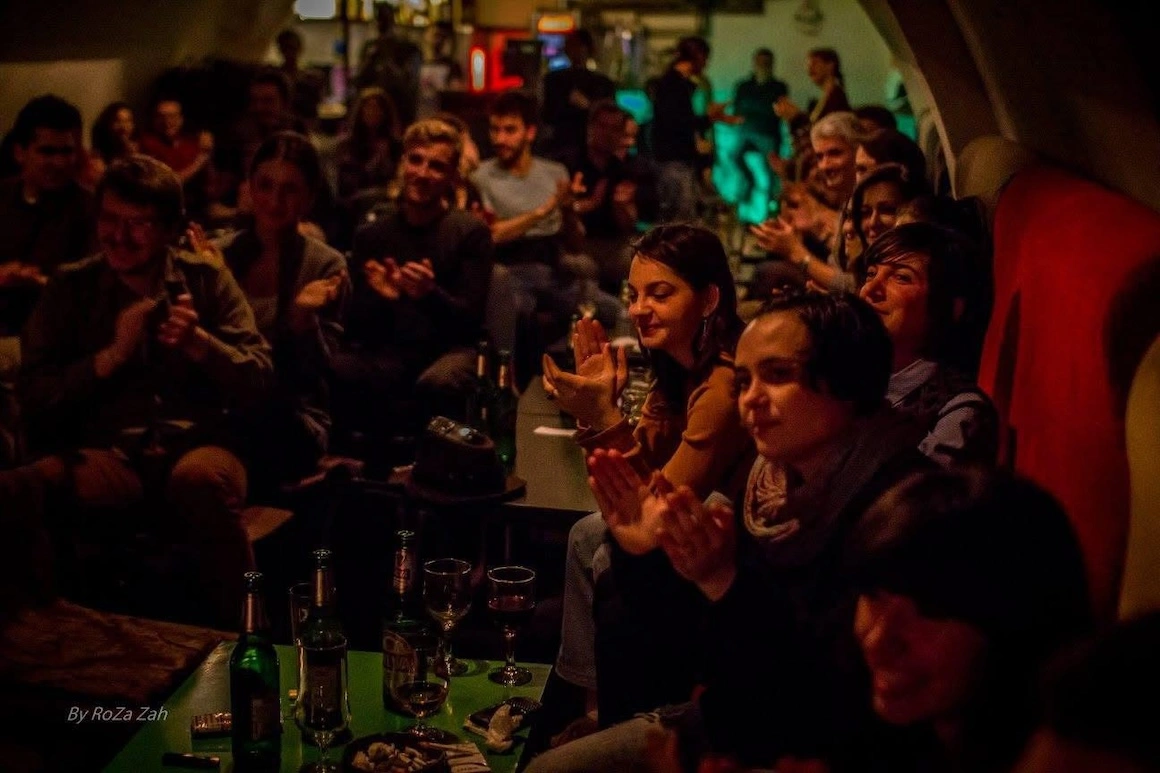
The atmosphere is intimate, the bar hums with people, and a bittersweet taste lingers in the air. On the tables, beside glasses of wine or beer and plates filled with food, here and there flicker faux candles with a warm glow. They cast a gentle, intimate sparkle that deepens the sense of closeness; we’re all here to remember the artist-pianist Tiberian: relatives, friends, longtime disciples, current students, colleagues, devoted admirers – a small yet tightly knit jazz family.
The evening’s program has two sections: the heartfelt tribute offered by several students, marked by well-known pieces from the genre’s repertoire and short stories about “Professor” Mircea Tiberian; followed by the reverence of his fellow performers, both old and new (singer Nadia Trohin, pianists Toma Dimitriu and Antonis Anissegos, percussionist Răzvan Florescu, guitarist Sorin Romanescu, Nicolas Simion, and Răzvan Cojanu), expressed through their own compositions as well as through works written by the late musician. As a motto of the evening emerges the vocalist-creator Nadia Trohin’s line, “it’s not over yet,” taken from the title of a piece he composed but that was never performed, thus becoming a symbolic formula of the continuity of the music and of his living presence in the memory of those who knew him and were close to him.
It is a bittersweet feeling, as I said, because the music performed does not follow a line of delusion or regret, but rather combines thrill, verve, turmoil, playfulness, dance, fury, helplessness, gratitude – an amalgam of states that admits no linguistic equivalent. It speaks about Mircea Tiberian and contains him: the pianist, composer, improviser, musicologist, founder of the jazz department and professor at the National University of Music Bucharest, the trailblazer, but also the husband, father, grandfather, mentor, stage partner, friend, the beloved and respected musician. In order to better understand all these facets in which we rediscover the deeply loved man, we turned to the voices of those who were close to him, asking them to bring him back to us through their memories and impressions.
“Mircea Was a Man of Singular Sensitivity”
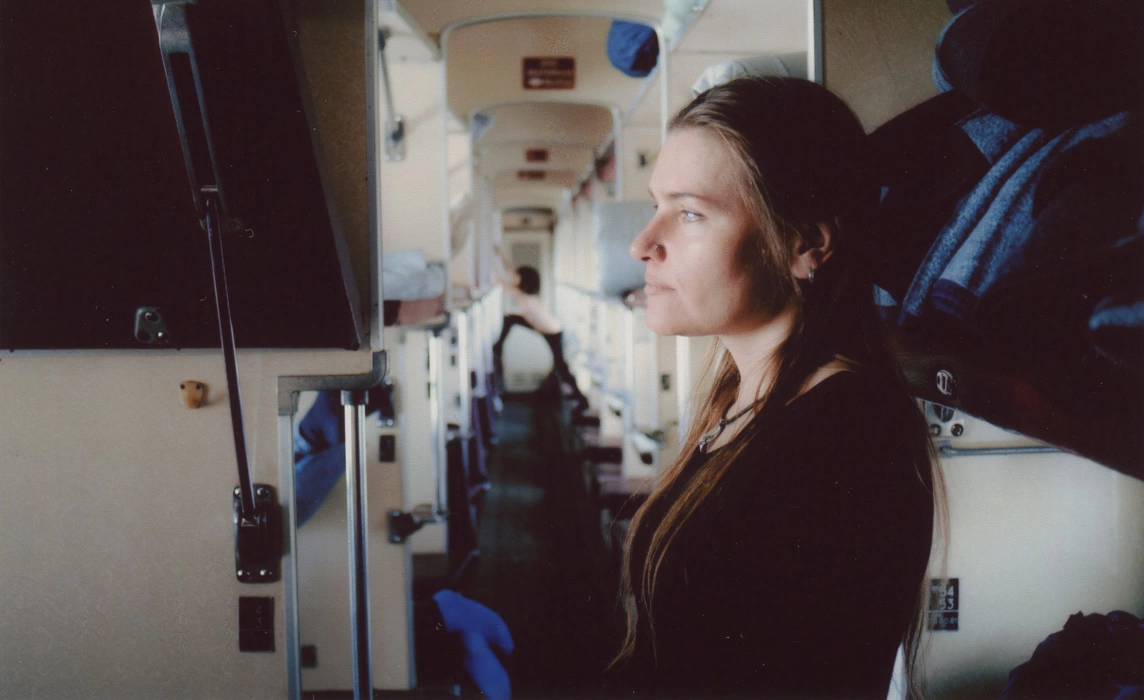
Ioana Tiberian (Cildus), his wife, poet
I do not have the slightest trace of doubt that, for me, Mircea was and will remain the most important person in my life. And my only regret today is that our partnership lasted just two decades. I call it a partnership because the word carries multiple meanings. Partnership means marriage, friendship, and a strong human bond between two people who carry the same burdens of life. Partnership also means camaraderie. A situation like that of our teenage son, who has severe autism, can take you out of circulation. And yet, at times, we would even end up blaming ourselves for not doing enough for his quality of life. That everything was becoming more monotonous, more numbing, more exhausting with each passing day. That the weight of it all overwhelmed you while you were still alive.
Mircea was a man of singular sensitivity. There isn’t enough space here for all that I could tell. He was a freak, as I like to say. And completely natural. Not pretended, not fabricated, not “artificially” intelligent. I don’t know how to live without his music invented on the spot. In the meantime, he always followed his own path, which proved to be a very complex one. Life with his students – until the very end. His musical life, with all kinds of administrative and managerial struggles, which he loathed from the depths of his being, yet which he strove to navigate respectfully. His musical life is in symbiosis with so many other artists: theater people, poets, visual artists. His support for students and the collaborations he later had with them. His ambition to constantly challenge them, to open up all kinds of horizons through musical knowledge, to support them in every sort of endeavor.
I know, it may sound almost excessively laudatory, but to answer directly by quoting Mircea himself: “Everything is true!” That was his response to a poem of mine that I had dedicated to him. I will carry that answer in my soul forever.
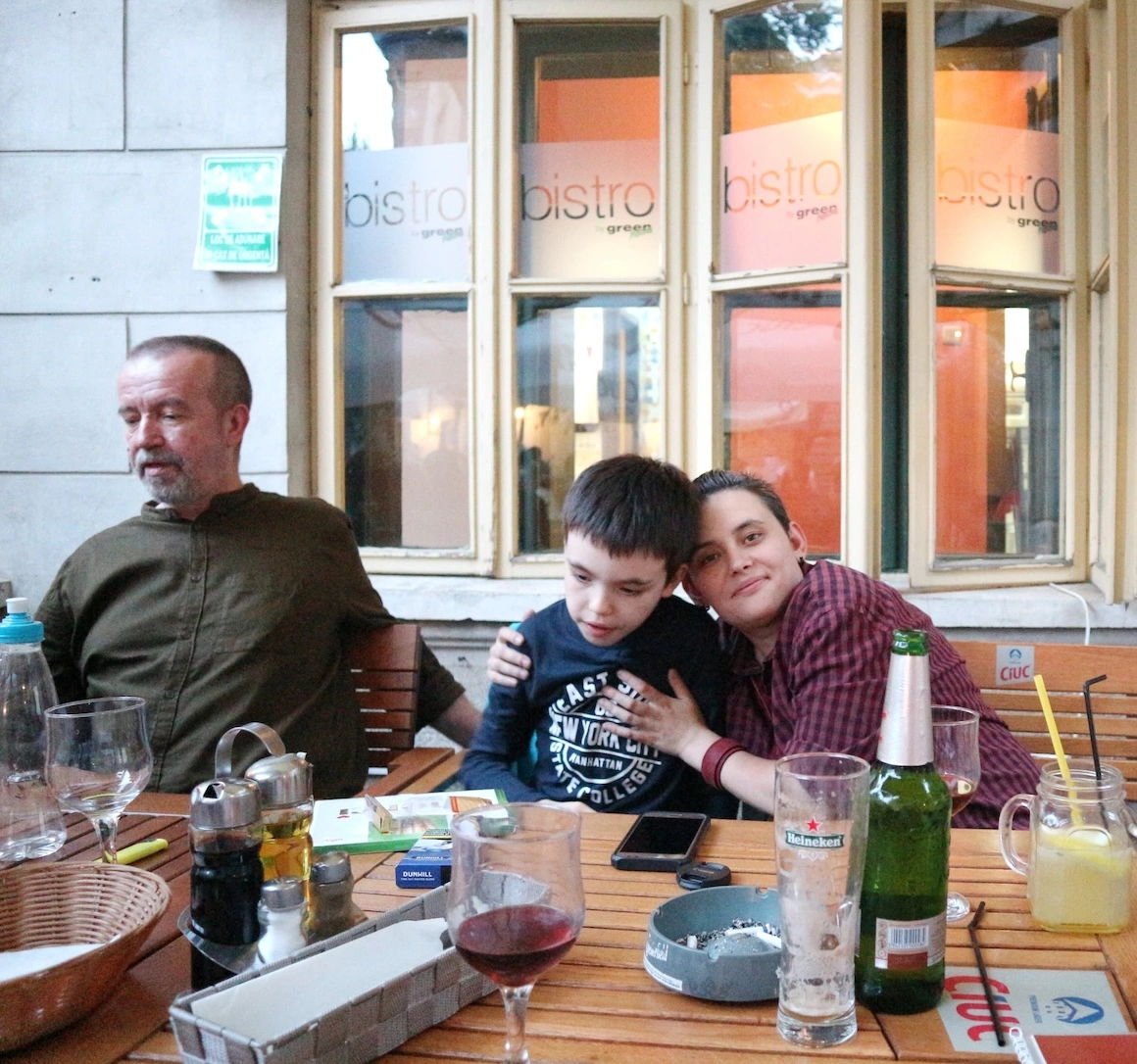
“The Legacy of a Free Spirit: Mircea Tiberian and the Music of the Three Beginnings”
Ioana Tiberian Amarița, his daughter, musician
From the first vibrations felt in my mother’s womb to the early improvisations on the grand piano, music has been our shared language. His music was my soundtrack even before I saw the light of day. I listened to it with reverence throughout my childhood, shaping my inner world in ways I only fully understand now, as an adult. Although opportunities to perform together were rare, Christmas remained our sacred space for gathering, singing carols or Bach chorales – a music that, for me, defines the spirit of the holidays.
My father always valued genuine, unfeigned emotions. This search for authenticity was reflected in everything around him: from the natural Christmas tree to the object that was his most faithful companion, the grand acoustic piano. This instrument was not just an object but a silent witness to his life, traveling from Sibiu to Timișoara, and finally to Bucharest. Today, the old piano is in the possession of my sister, Anca. It is a great joy to know that the instrument is still functional and that we can tell future generations: “Mircea Tiberian played and created on this piano.”
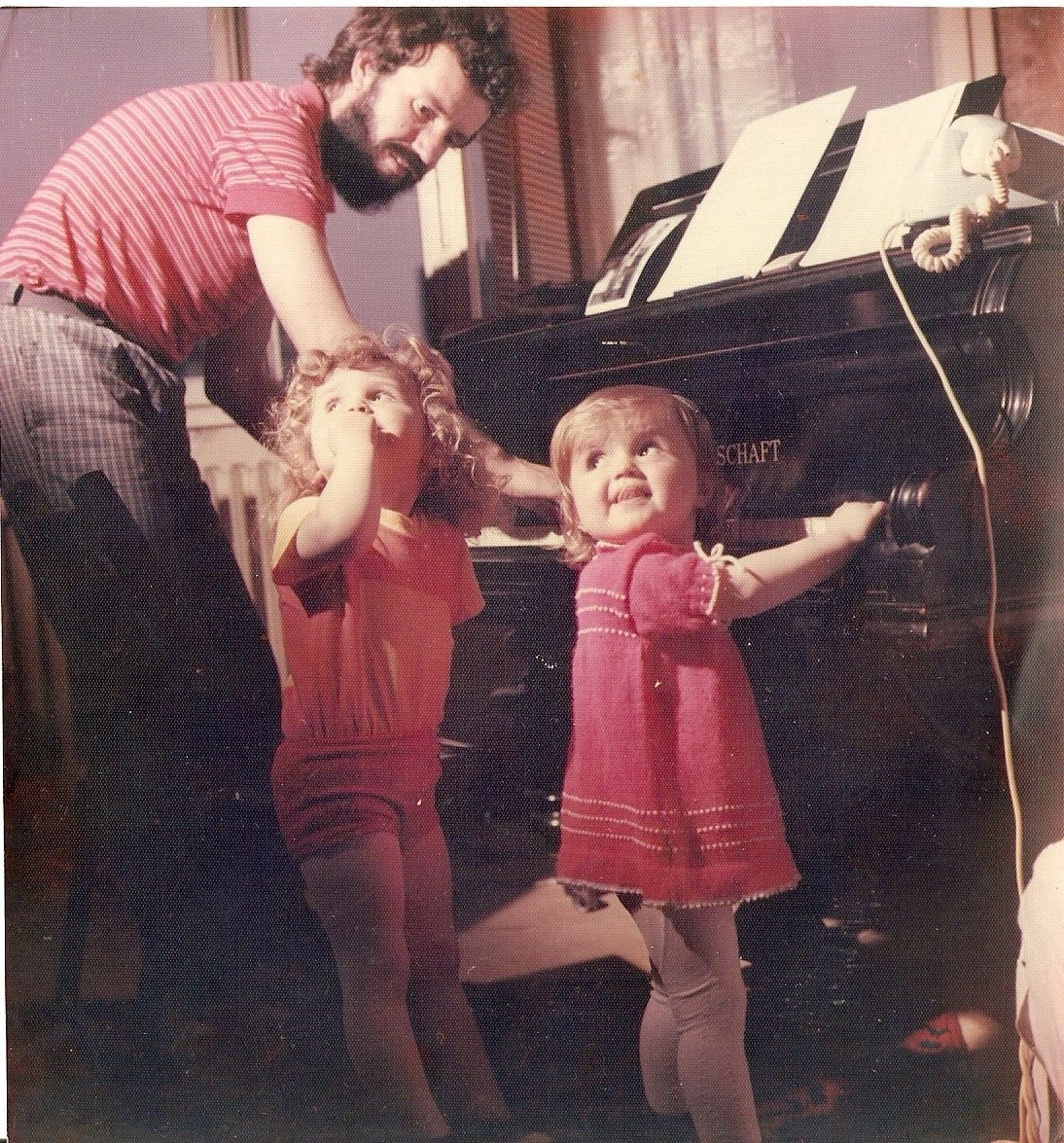
Looking back, I understand that his solo piano albums had the greatest impact on me. In the late ’90s, during a bleak period for Romania and full of challenges for our family, my father released Hotel of Three Beginnings.
The album title carries a special symbolism. The hotel represents a transitional space, a place where past, present, and future meet for a moment of introspection – a crossroads for him, a point where he felt the need for new beginnings, filled with hope and multiple possibilities.
The album also includes the piece “Anca and Ioana,” dedicated to me and my sister. It is one of his most luminous and melodic compositions, a sonic portrait that moves me every time. It is a rare opportunity to see myself through his eyes – a projection full of light. Recently, this piece was given a new life as part of the soundtrack for the film Codobelcul, directed by Cornel Gheorghiță.
Even though at times it feels as if our “bubble” shrinks and the world becomes less sensitive to jazz, my recent encounters with listeners of this genre remind me not to lose hope that there will always be people who appreciate beauty. I invite you to listen to the double album Hotel of Three Beginnings / Back to My Angel. There, among the keys and silences, perhaps lies the essence of who Mircea Tiberian was – a composer and improviser.
“An Irrecoverable Loss for the World of Jazz”
Florian “Moșu” Lungu, radio and television host, composer, musicologist, and professor
On the morning of October 18, 2025, an irrecoverable loss shook the world of original jazz and Romanian music as a whole. The septuagenarian, multi-talented artist Mircea Tiberian passed away, just a year after celebrating half a century of total dedication to the altar of sound art. His principal contribution to the emancipation of the Romanian jazz scene consisted of a multifaceted, all-encompassing involvement, taking multiple forms.
He was a remarkable pianist, applauded both at home and abroad, possessing a technique mastered with aplomb, paired with the artistry of an inspired improviser, as well as a soloist on piano, synthesizer, harpsichord, and organ. As a bandleader, he generated ensembles ranging from duos to various combos and even big bands. An omnipotent composer, he created hundreds of works, many immortalized on dozens of albums. A skilful arranger, he was also a mentor to the younger generation as a university professor and doctor of music, founding jazz and improvised music modules at higher education institutions in Bucharest and Cluj, and integrating the study of this musical genre at the level of music high schools.
He organized and coordinated musical life in numerous capacities, including as a member of the Committee for Approval of Artistic Projects for the Bucharest City Hall and as curator of the Jazzy Spring in Bucharest festival. Not least, he was a prolific author, publishing jazzological and educational works such as Musical Notes and Notes About Music, The Book of Music, two volumes of the treatise The Technique of Improvisation, Jazz Inside Out, The Reference Sound and the Ark of Western Music, The Musical Domain: A Four-Dimensional World, Magister Musicae in the Land of Smile, Creative Accompaniment on Piano and Keyboards, some of which include illustrative audio CDs, as well as Dragonfly Blues and The Melodies of Bucharest of Yesteryear – Arrangements by Mircea Tiberian.
Furthermore, in numerous concerts and recording sessions, the duo Mircea Tiberian & Nadia Trohin made it their conscious mission to reinterpret, in jazz versions, the timeless hits of Romanian pop music from the previous century. Together with German drummer Maurice de Martin, Mircea Tiberian founded the open-format group and cultural network Interzone, through which they carried out numerous exciting musical projects and recordings.
“The Moments with Him Playing, Sometimes Laughing While He Played, Remain for Me the Symbol of His Universe”
Ana Dubyk, former student, jazz vocalist and composer, piano therapist (Piano Therapy Association)
The walks in Cisnădioara during the Icon Arts Camps. The last birthday celebration at Jazzbook, where we gathered to honor his 70th year. Birthdays at Green Hours, in attics, living rooms, at the museum – occasions to hear all sorts of stories, incidents, and hours of listening to music. Jazzy Tarot at the Museum of Literature, Jazzy Tarot at Green Hours transformed into Tarot Tales at the Romanian Playwrights’ Theatre, the musical he wrote, which built some beautiful friendships among the vocalists who passed through the jazz department of the conservatory. The last cigarette smoked indoors at Green Hours before the law changed. The concert with him, John Betsch, and Michael Acker, for which I will always be grateful. Jeanne Lee. Charlie Haden. Liberation Orchestra. When we listened together to the recordings of what would become Halcyon, my last album. The chance encounters near the Conservatory. All of these – and many more – are memories I hold dear.
Yet the image that remains with me is of him playing solo. I don’t think there was a single one of his concerts where I didn’t cry (even a little), no matter what beautiful ensemble he chose. And these moments with him playing, sometimes laughing while he played, remain for me the symbol of his universe – a universe I am immensely grateful to have had the chance to discover.
“He Was Deeply Connected to His Intuition – in Playing, Writing, Speaking, Living”
Ioana-Teodora Spînu, former student, jazz vocalist
When I think of Mircea Tiberian, the image that comes to mind is “the best spot to see the most beautiful sunset in Sibiu.” I took his word without hesitation the evening he gathered a few of us from the Cisnădioara camp and brought us there to tell us stories about the city streets he carried deeply from his childhood.
I remember very clearly the trance he would enter while on stage, whether in small ensembles, larger groups, or solo. I absorbed it eagerly, observing closely how much playfulness and freedom were in his way of playing. He often had moments when he would laugh after performing a particularly “good” phrase, a quote, or even something seemingly “out of context,” which he would instantly turn to his advantage – especially when playing solo.
He often told me that I resembled someone, but never said who. He would tell me “take yourself seriously,” when I didn’t even fully understand what that truly meant. I think this was his subtle way of “scolding” me gently when needed, out of careful concern, so I wouldn’t close myself off further.
I am grateful that he encouraged me to return to Bucharest and pursue my master’s studies. He had said: “You should think of a way to return to Bucharest, before you forget the difference compared to Constanța… even if it can’t happen right now. It would be good to stay connected to music.” When I returned, he also included me in the Tarot project at the Romanian Playwrights’ Theatre, and somehow the deck of cards we were using ended up in my hands. I felt this as both a responsibility and a vote of trust.
In his final period, he was always close, involved in everything I undertook, wherever our paths took us. Usually, after a concert, we would quickly catch up on “the news”. I am amazed at how close I felt to him. More than a father or a mentor, Mircea Tiberian knew how to “descend” enough times to be our friend.
His intuition always fascinated me—how deeply connected he was to it, in playing, in writing, in speaking, and in living. For me, this openness to being present, alive, and attentive was one of the most precious lessons, one that continues to accompany me.
“Mircea Tiberian Had the Power to Make You Feel Truly Validated”
Izabela Radu, former student, vocalist and music education teacher
For me, Mircea Tiberian remains a cornerstone on which my entire musical journey at university was built, starting with my involvement in the Jazzy Tarot project, and continuing even after completing my bachelor’s and master’s degrees, when I still felt his influence on my musical tastes. I timidly began courses at the National University of Music Bucharest with zero experience in jazz – a fact he noticed even at my entrance exam. I think I was always seeking his approval, because he had the power to make you feel truly validated whenever he reacted to your performance. Sometimes he would smile at the corner of his mouth, other times he would exclaim with an onomatopoeia… or simply knew exactly what to say, just enough to make you feel like an experienced astronaut on the Moon.
He had a sense of humor, and although he could be intimidating, his hearty laugh broke down the barrier of age and drew us in, bringing us into his world. His world… a place he seemed to retreat to whenever he was at the piano, tongue in the corner of his mouth, forgetting everything around him and dedicating himself entirely to serving the instrument, or showing perfect respect for the soloist or moment he accompanied, responding intuitively to the performance of the one alongside whom he played.
I was lucky… truly lucky to enjoy the presence, the creation, and everything that Mircea Tiberian embodies in this universe far too small to contain him. Thank you for the chance, Maestro, for your trust, and for the time – too little time.
“Mircea Tiberian Was an Entire World”
Luiza Zan, jazz vocalist
Mircea Tiberian was a benchmark of Romanian jazz. He shaped it, transformed it over decades of teaching and performing. The impact of his loss is immense – not only among his friends and students, but especially for higher jazz education. I first heard him at a student festival in Cluj, in 2003. He played solo on the piano, and I stood somewhere in the middle of the hall. He wore his hat, always present at that time. The recital was so moving that I cried. His music sounded like the soundtrack of a romantic film, with unrequited love, unspoken longings, and books – so many books.
We began performing together in 2004, and then he offered me a place at the jazz department of the National University of Music. We had different visions, so after two years I left – but those two years meant a lot to me and to the voices I helped shape in that jazz laboratory. I owe him so much: musical discoveries, lessons that I apply in my own music and will never forget. Evenings filled with stories, gossip, and laughter, which had a special charm when shared with Mircea. Romanian jazz slang, an entire array of expressions invented by him, which all Romanian jazz musicians still use today. Art films watched at Art Jazz Club, concerts at Lăptăria lui Enache – these will always be missed.
A lost world, but never forgotten. Mircea Tiberian was an entire world.
“Mircea Tiberian Was a Creative, Rebel, Exploratory Jazzman”
Nicolas Simion, saxophonist
An attempt to portray a friend and stage partner: in a way, we began together and parted together – closing a circle, a cycle in our lives that lasted 45 years.
It was around 1980 when, as a student at the Conservatory, I met Mircea Tiberian. I believe he had finished his pedagogical studies, like me, but he still came to practice during his free afternoons in the piano rooms on the fourth floor. In the attic where he lived he didn’t have a piano, and in the places where he played – at theaters, night bars, and restaurants – he couldn’t study and play “that way”! During those years, we played together quite a lot. My first real experiences were with him. I played alto sax, and for some pieces he would suggest motifs and phrases to me and my colleagues for our improvisations. He knew what he wanted and what he didn’t like! His critical sense became legendary; sometimes he couldn’t even refrain from commenting on mistakes or inconsistencies in the band during a concert… Not out of malice, though his ironic style could be sharp, but it was justified by an artistic conscience that gave him no peace.
He was always in the company of poets, painters, and even writers and philosophers of his generation, meeting at terraces or restaurants (the Writers’ Union or Green Hours) for “a glass and a chat”! By the way, he wrote several books on jazz, art, and musical aesthetics, which I warmly recommend. They are not easy to read or understand, but they are worth reading and rereading. They are like his music: you only start to like them the more you listen, becoming familiar with their language, their sonic world. It’s jazz, but not just jazz – it’s more, it’s his art, his sound world, his spiritual world.
I would hear him improvising alone, exploring new sound worlds, experimenting with complex harmonies, unheard melodies and rhythms! It was fascinating to watch him enter a kind of trance and play free, spontaneous music, exploring different moods – from calm ballads to Afro-Latin rhythms in modal jazz, where you could hear influences of Enescu, Bartók, or Hindemith, but also McCoy Tyner, Keith Jarrett, Herbie Hancock, etc.
In 1986, when I invited him to collaborate and co-lead the group Opus 4, and a year later we included saxophonist Dan Mândrilă, he took a step further, composing and arranging certain pieces– original compositions or even modern works for us! We played together at all festivals and clubs in Romania during that period, and we were lucky to perform for almost two years at the Jazz Club of Hotel Nord in 1987–1988! Also in 1988, we developed a Duo program inspired by Dave Liebman and Richie Beirach, experimenting freely with a kind of chromatic, pan-tonal “Free-Bop”! Our international success with Opus 4 & Dan Mândrilă included participation in June 1988 at the Bühne Jazz Fest in East Berlin.
All those jazzmen of his generation, with whom he communicated differently, played modal jazz, sometimes with free spaces, free music of the ’80s, with slight funk and fusion influences – but he preferred piano or Fender Rhodes electric piano over synthesizers, without imitating popular bands of the time like Weather Report, Chick Corea, Spyro Gyra, George Benson, etc.
To tell the truth, Mircea was not an admirer of Bebop or Hard Bop, and he didn’t like playing Swing, although he could do it well! He admired ECM, was introverted, a loner who struggled with himself, often dissatisfied and “angry at life,” but with humor. He loved recounting scenes from our shared experiences; I laughed until I cried at the crazy jokes we made, the English – sometimes very dark – humor we shared. In those years, he listened to a lot of jazz and understood like no one else how a rhythm section works, how the drummer should use cymbals, and what notes and rhythms the bassist should play for it to sound good together. He even showed me some drum transcriptions of Jack DeJohnette, or Dave Holland on bass, etc.
Mircea was a great accompanist, playing with virtually all Romanian jazz vocalists, including Aura Urziceanu, Anca Parghel, Marta Hristea, Maria Răducanu, Nadia Trohin, and others. We recorded two CDs together: one in Vienna in 1996, At the Oriental Gates (TUTU Records, Germany), and the other Tribute to Jancy (Körössy) recorded at ARCUB in Bucharest in 2014 (7Dreams Records).
Mircea was a creative, rebellious, exploratory jazzman. He always sought out people with whom he could truly communicate. He was not a “bebop” player nor a fusion pianist like some who can play multiple jazz styles but cannot be themselves. Unfortunately, some have the ease to imitate, absorb models like Oscar Peterson, Chick Corea, Bill Evans, etc., to appeal to audiences and succeed. But Mircea wanted more; he wanted to play what his inner ear, his intuition, dictated, to be himself – even if not everyone understood or appreciated him. He was the only Romanian jazzman who could sit at the piano and play a solo program without relying on standard repertoire or his own compositions, but to be spontaneous and free, present in that moment of grace, even at the risk of getting lost in a labyrinth!
We are a small family of Romanian jazz; when one of us leaves, a void remains. As he said: “It’s not over yet… time puts everything in its place.” Farewell, Mircea. May your flight be smooth and may you find peace and quiet in the heavens above, Amen. Your friend, Nicolas Simion.
“Mircea Had an Extraordinary Musical Soul”
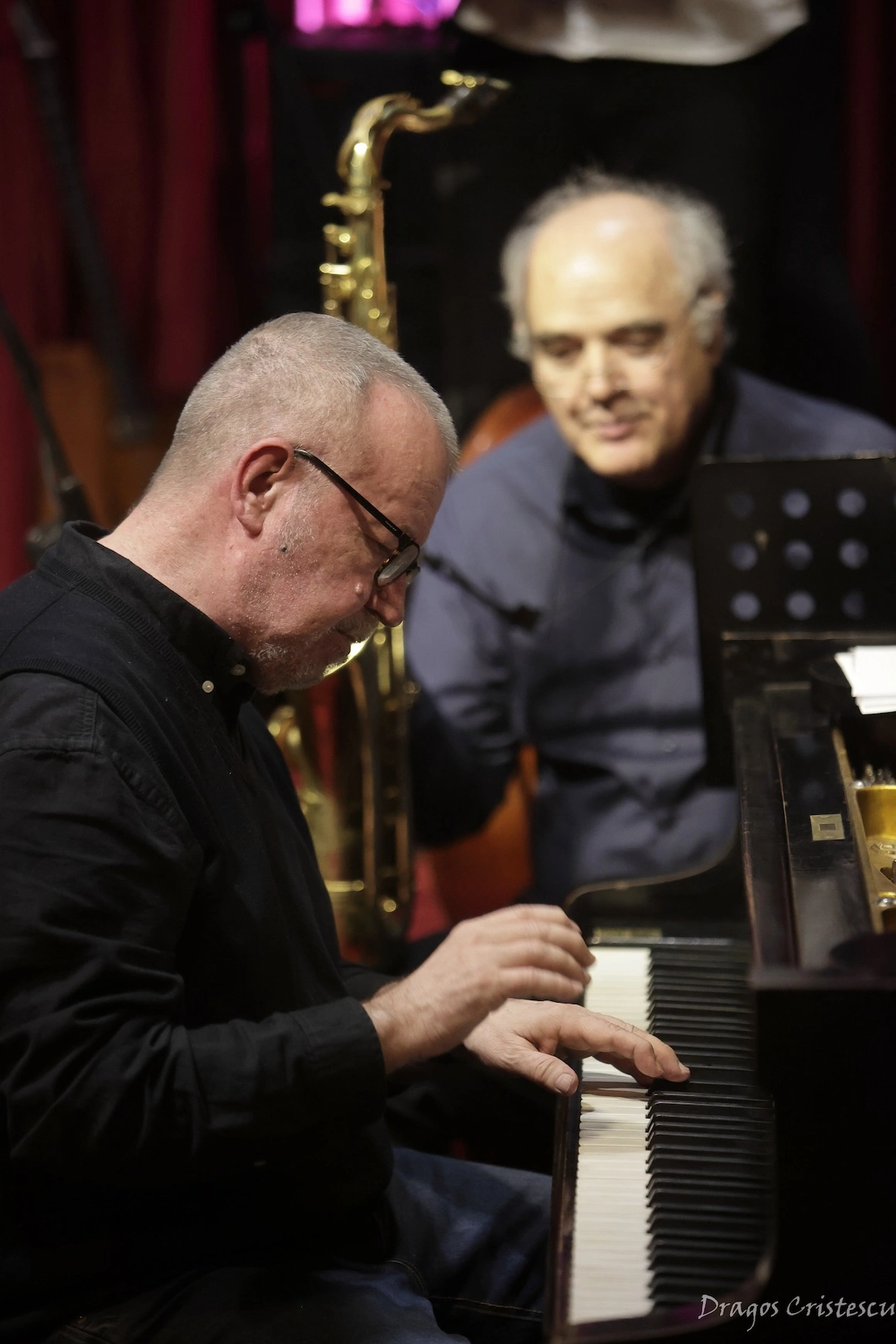
Toma Dimitriu, jazz pianist
Mircea Tiberian was a dear friend, a mentor, and a pianist who inspired me enormously. I learned so much from him – from our conversations, from the nights we spent talking on the phone for hours, from the jokes shared at the terrace. He had an incredible sense of humor. There are so many beautiful memories that bind us, it’s hard to put them into words.
We had known each other since I was 12 years old, which means twenty years had passed… The true space of connection was the time spent at two pianos – during rehearsals and in our duo concerts. That’s where I got to know him best: in those moments when we literally felt each other’s pulse.
When we played together, there was no desire for pianistic showmanship or gratuitous displays of virtuosity. It was a meeting space. Music was not only a goal but also a pretext. We patiently sought the “connection zone” – the moment when you simply trust the other person and there’s no need to impose anything. Fingers move by themselves, and the mind becomes a spectator. When we found that space, we smiled at each other.
It was the most beautiful feeling possible.
And especially in fully improvised pieces, this space became extremely intimate. At two pianos, you feel the other exactly as they are: you understand what compromises they are willing to make, what changes in direction they accept or propose; you follow who leads, from one moment to the next, and who follows. Mircea had an extraordinary musical soul. He was incredibly generous and immensely creative. He offered a world dense and full of nuances – a world that I carry with me forward.
“Mircea Tiberian is a Story Without End”
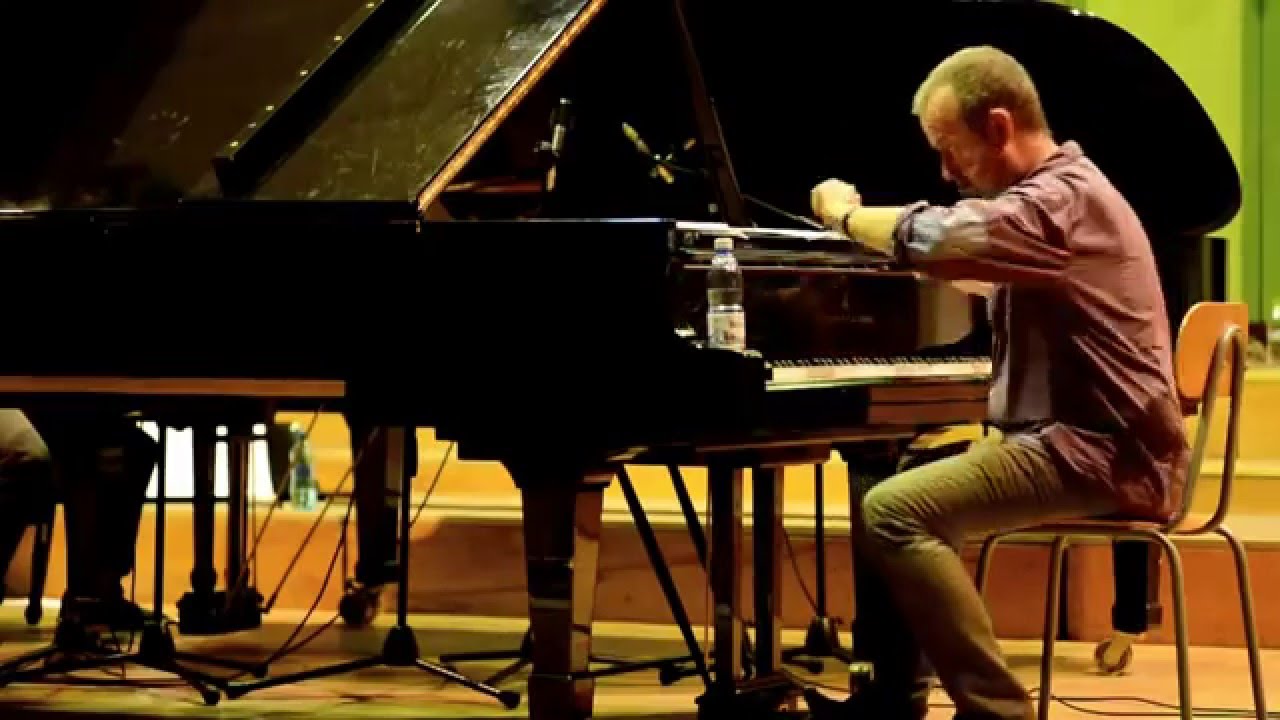
Nadia Trohin, jazz vocalist
I was incredibly fortunate to know Mircea Tiberian up close – the artist and the man with whom I shared a truly special relationship, and about whom any words I could say would fall short. I met him during my student years, when he was my professor, and fortunately for me, his lessons never ended in the classroom. The numerous concerts we later performed together and the long journeys we took were true life lessons. He used to say that a musician should not play with someone with whom they have no affinity or with whom there would be nothing to discuss on possible trips.
On stage, he was a generous partner: he knew how to listen like no one else, effortlessly shifting between the roles of soloist and accompanist; he surprised me every time with his harmonic constructions and the richness of his sonic worlds… He was a true master! Although he never liked that term.
He always put music first and disliked those who did not, miming or playing without feeling. He could not tolerate falseness in music. In fact, he taught me what authenticity means and what it is “to play with your soul,” for which I will always be grateful. To quote him: “In art, we can only do what we are able to; there is nothing to prove – we can and must play authentically.”
Although it is not easy for me to find the words after his passing, I know his spirit will endure as long as we read his writings and perform his creations, carrying forward his legacy. Because yes, Mircea Tiberian is a story without end, or a Never Ending Story (to recall the title of one of his albums).
“Mircea is Impossible to Replace”
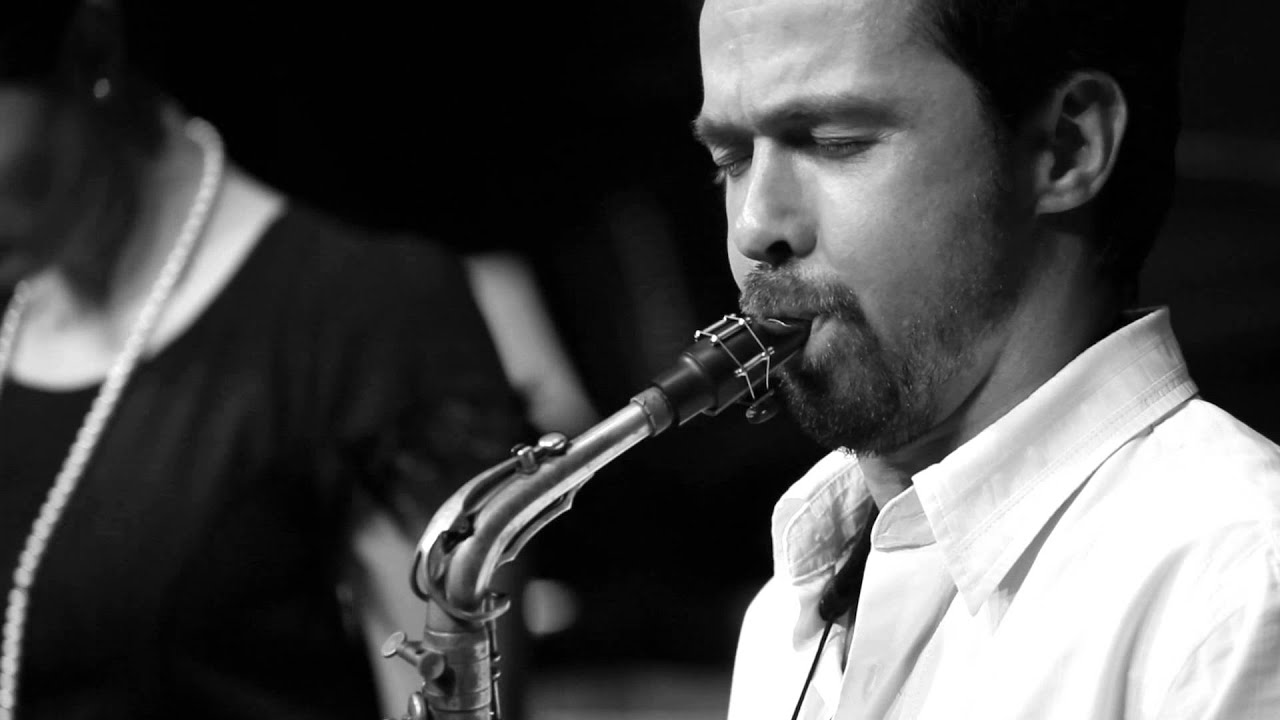
Eugen Suciu, poet
In my view, in recent years, Mircea was the only person with whom I could talk about absolutely anything – and here I mean, though it may sound grandiose, any “cultural” subject. He was a man who knew a lot: history, geography, literature, and of course music. He was one of the few who still read poetry. He was a warm, well-rounded, ironic man with whom you could discuss anything. Believe me, it is very hard for me to speak about him – we were very close. Every day we called each other and asked, “Are you going out today?” – we couldn’t wait to meet. Mircea is impossible to replace.
“He Didn’t Behave Like a Star; He Was Very Modest”
Cornel Gheorghiță, director, screenwriter, producer
Mircea appeared in my film Codobelcul – there are two scenes where he plays himself. But his most important contribution was the music: the entire soundtrack consists of his already existing compositions. Although the premiere took place on December 5 at Cinemateca Eforie, I showed the film to Mircea before he passed away. Normally, he would have been with us at the premiere, but instead his friends – Nicolas Simion, Nadia Trohin, Toma Dimitriu, and others – performed a one-hour recital in his place. Mircea had seen a few of my films, and of all of them, I think he liked a documentary about rural brass bands in Moldova, Fanfaron Fanfaron, the most.
I met him in Sibiu at the Jazz Festival, when I was a student, in the 1980s. We were all there during the festival, meeting and talking – I already knew Johnny Răducanu – and I naturally met Mircea Tiberian and Harry Tavitian. It was a gang, we talked about everything, but not much about music. Mostly about foreign guests, the situation in the country, telling jokes. It was pure joy, without music theory, just friendly chats in cafés and pubs.
In Bucharest, after the Revolution, I would go to the terrace on Calea Victoriei at the Writers’ Union, where Eugen Suciu was the host, gathering writers, painters, sculptors, all kinds of artists. Those were nostalgic times, yet we were optimistic. It was a bohemian terrace. When it closed, we moved to Green Hours, where Mircea also performed. The last times we gathered at “La Copac” – it was a pleasure to see each other, and of course, under the effects of Bacchus [laughs].
Mircea had a very well-developed sense of humor, which drew us close. We discussed many things, and I was impressed by his vast culture – there weren’t many like him; he knew everything about music and paid attention to old and new, symphonic, popular, traditional, and light music. I learned a lot about the music scene behind the scenes in the country. He was well-informed, extremely curious, and our conversations spanned all directions, even history and antiquity.
Although he was a luminary in jazz, he never acted like a star – he was very modest. He was generous and ironic. I never saw him argue with anyone; whenever he expressed an opinion, he did so with humor and irony, never with hatred or anger (even when, say, we were angry at the government). He was a good man, and he remained that way despite the upheavals we experienced in the years before the Revolution.
“The Reference Soul”
(with and about Mircea Tiberian)
Adrian (Adilă) Pârvu, poet
Just as the law of physics propagates sound separated from vibration, the laws of music keep them tightly connected, launching them simultaneously, miraculously intertwined in a sonic vibration. That’s what you used to say, knowing that this sonic vibration dissolves our souls, provokes deep inner experiences, and harmonizes us with the great cosmic composition.
I don’t know how it occurred to you to throw a musical score onto the chessboard, then brilliantly interpret the consequences of this surprising gesture. In other words, the king is the reference sound, and the queen is the melody. Vertical or horizontal harmonies rest on the rooks’ columns. The oblique moves of the bishops, along coordinates of musical space and time, traverse the fields covered by the knights’ leaps from fourth to fourth. The indestructible chain of pawns embodies the tenacity of construction, but also the dream that at least one of them may become a queen.
In the few italicized lines, I have noted – somewhat clumsily – ideas and words of Mircea Tiberian (see, buy, and read the volume The Reference Sound and the Ark of Western Music). But only after his passing did I understand what Mircea was able to give us all with every touch of a key, every composition or improvisation, every book published, every generation of students he trained, every witty remark, every vibration of his reference soul. He managed to offer us a little piece of heaven. Some of us received it indifferently, others with devotion; some with strange awe, others with justified enthusiasm.
My little piece of Tiberian heaven was on a sunny spring afternoon when, on the terrace of Green Hours, he asked me to stop chatting and listen together to the chirping of a pair of blackbirds. “Why are they arguing?” I asked, trying to sound clever. “They’re not arguing – they’re falling for each other!” he replied, seriously and convincingly. So convincing that even today I am sure Mircea could decipher the birds’ trills, the rustle of leaves, the whistle of the wind, the lapping of waves, or the apparent silence of the stellar deserts. Amen!
“A Piano Played by Butterflies”
Ion Mureșan, poet
My brilliant friends have departed one after another to what Ioan Groșan called “the literary circle in the heavens.” But their deaths also took for me the form of immersion into a tray of photographic developer. Suddenly, I began to see in them what I had not noticed before, struck by a strange blindness: genius. The most recently departed, who did not even have the chance to say Adieu (that is, au revoir au Dieu), was my composer, pianist, teacher, and friend, Mircea Tiberian.
He honored me by accompanying several of my poetry recitals on his piano. I often took pride in that. But later, reading in one of his books that members of a jazz ensemble must have compatibility and trust, otherwise “musical meanness” may arise, I felt even prouder, because it meant he had trusted me and my poetry.
Of course, Mircea was an excellent teacher. From his books, I learned the little I know about jazz. But I consider him a great artist for another reason: Mircea Tiberian was a great poet, a visionary poet. In one of his interviews, when asked about inspiration, he admitted that when composing and improvising, overwhelmed by rhythms, structures, forms, harmonies, scales, etc., he could lose his way, get lost, if not for a force, a hand from outside, guided him. Then I saw him – fragile as he was – moving through the downpour of the world’s sounds, choosing his path by the light of flashes. Just as a true poet feels the visible and invisible world with words, Mircea Tiberian felt the visible and invisible of this world with the sounds of his piano.
In an interview in Sibiu, he recalled that his first piano teacher’s house was filled with display cases containing large, exotic butterflies, and that he could never forget it. I believe that Mircea’s fingers played the piano as if large, exotic butterflies rested at their tips.