
During art week on the island of Hydra, amidst mules, freddo espresso and art collectors with astronomical budgets, Andra Ursuța’s sculptures installed the apocalypse in the space where animals once awaited sacrifice — a slaughterhouse overlooking the Aegean Sea.
With thanks to Ulrika Carlsson and Andrea Nastac
When you first set foot on the island of Hydra, you feel something is different. Is it the mules? (We don't drive here.) Is it the spacious, elegant awnings, or the marble altar at the Cathedral of the Saronic Islands, a sign of the wealth amassed generations ago by the island’s sailors? Here, stylish hats walk about with people beneath them.
In May, people were already calling the summer of 2025 White Trash Lotus Summer. But Hydra is not trashy, it’s posh. Towards the end of June, the island hosts an art week of sorts, an unofficial after-party lasting several days for those who come here straight from ArtBasel. This is a place where they can cool off on the beaches that Sophia Loren has surely visited, enjoy a freddo espresso at the Pirates' Bar, listen to gossip whispered behind fans — not in the ballroom, but on the seafront — or take a small pilgrimage in the early hours to the Monastery of the Prophet Elijah, followed by a hike up Mount Eros. The day ends with fireworks bursting from a ship in the bay during the island's traditional festivities, Miaouleia.
During summer, Hydra is also inhabited by people who were always a little too competitive — and whose substance use has only heightened that tendency. Among the residents are potential buyers, members of royal families from the Persian Gulf, or simply Asian businesspeople with budgets of tens of millions of euros for contemporary art purchases. All are drawn to the island during its art week, when Hydra makes you think that some people have taken the HBO series as a model, not a warning — and you can almost chart the microaggressions against the art market’s ups and downs. At one point, I watched partygoers leaving the Four Seasons Hydra to board the water taxi. I thought that everyone — on shore and on the boat — would happily see it sink just to spite the other.
This year, we were all drawn to the island for the exhibition Apocalypse Now and Then by Romanian artist Andra Ursuța, on view at the Deste Foundation until 31 October. Ursuța is as mysterious as she is successful. Represented by David Zwirner, whose sales include the standout Ortodoxctrinator, she has exhibited three times in the central pavilion at the Venice Biennale. Soon, one of her sculptures will occupy public space in Trafalgar Square, and both she and her works appeared in Luca Guadagnino's film Queer (2024).
On the evening of the opening, the exhibition unfolded against a spectacular sunset somewhere beyond the Peloponnese peninsula, like a choreography of considerable dimensions. A long, perfectly continuous queue led to the former slaughterhouse on the island, completing the scene. At first glance, you could say these people are in awe of success, waiting to enter the exhibition as if about to kiss holy relics. Jeff Koons' sun rises idolatrously over the small building. It is full of meaning and empty of content at the same time. It can be generous, but it can reject you at any moment.
Apocalypse Then and Now is an exhibition that "meditates on a barrier." It was conceived as a personal exploration of an ancient matriarchal civilization and its decline. Andra Ursuța's sculptures resemble assemblages, in which parts of the artist's body or those of her loved ones are found among the broken elements. The meanings of their titles are fragmented. "All the works contain a little alcohol," the artist confessed during a press conference held at the cinema on Hydra and moderated by curator and art critic Massimiliano Gioni.
An extension of the former slaughterhouse on Hydra is divided into three cells where animals used to be kept awaiting death. These small spaces now display works united by the common theme of violence and death. Some of the works are part of a series called Desolation Ware and consist of bronze sculptures cast using the lost wax technique. They are the traces of a civilization that cannot be placed in a specific time period, as it uses technologies from several eras, even ones that have not yet happened. The artifacts seem to come from Atlantis, as if they had just been unearthed in Antikythera. Whether they are pieces of furniture or ceramics, these sculptures speak of violence and ἀνάγκη – necessity or the torment of destiny. But the ornamental bronze chairs, resembling thrones, evoke hierarchy: control and submission. The artifacts seem to have survived a violent event and thus constitute the memory of a civilization that has collapsed – or will collapse. All this is presented by Ursuța, of course, against the backdrop of an impression that we may be witnessing the decline of one order and the rise of another. The violence reflected in her sculptures is both a testimony to the merciless fate of Greek mythology and to the psychological violence of our times, as described by philosopher and cultural theorist Byung Chul-Han: the subtle, internalized pressure to achieve, which leads to exhaustion. A somewhat anthropomorphic metal device looks like both an instrument of torture and the scales of justice of the goddess Nike. The "Byzantine" vessels, filled with food or drink, could just as well be bombs.
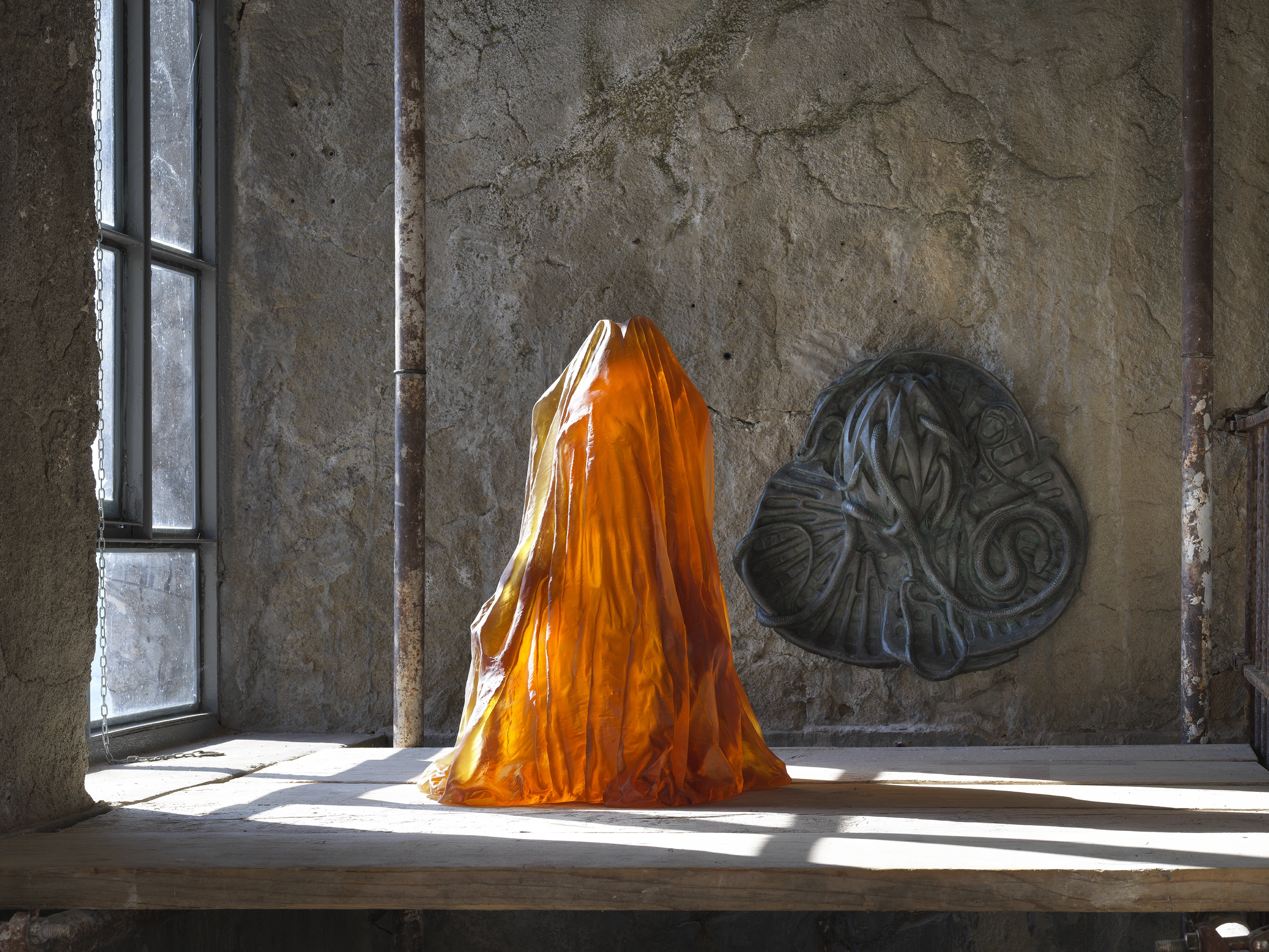
Two interconnected works caught my attention the most. One, Grande Odalisque, made of orange cast glass, features a veil that seems to cover a skull. In itself, it evokes the mantilla, the mourning dress worn by Andalusian women during Holy Week. However, the title, borrowed from Ingres' painting, forces us to consider the difference between fertile, vibrant youth and emaciated old age. Ingres' sexy young woman turns her back on us. She has no more than a second to meet our gaze: in the next moment, she will return to looking ahead. After all, as philosopher Ulrika Carlsson comments, she has a civilization to build. We, looking at the eye sockets suggested behind the orange glass veil, are reminded of the honey traps that appear in various stories —- the illusion of a sensual young woman, concealing a body touched by decay.
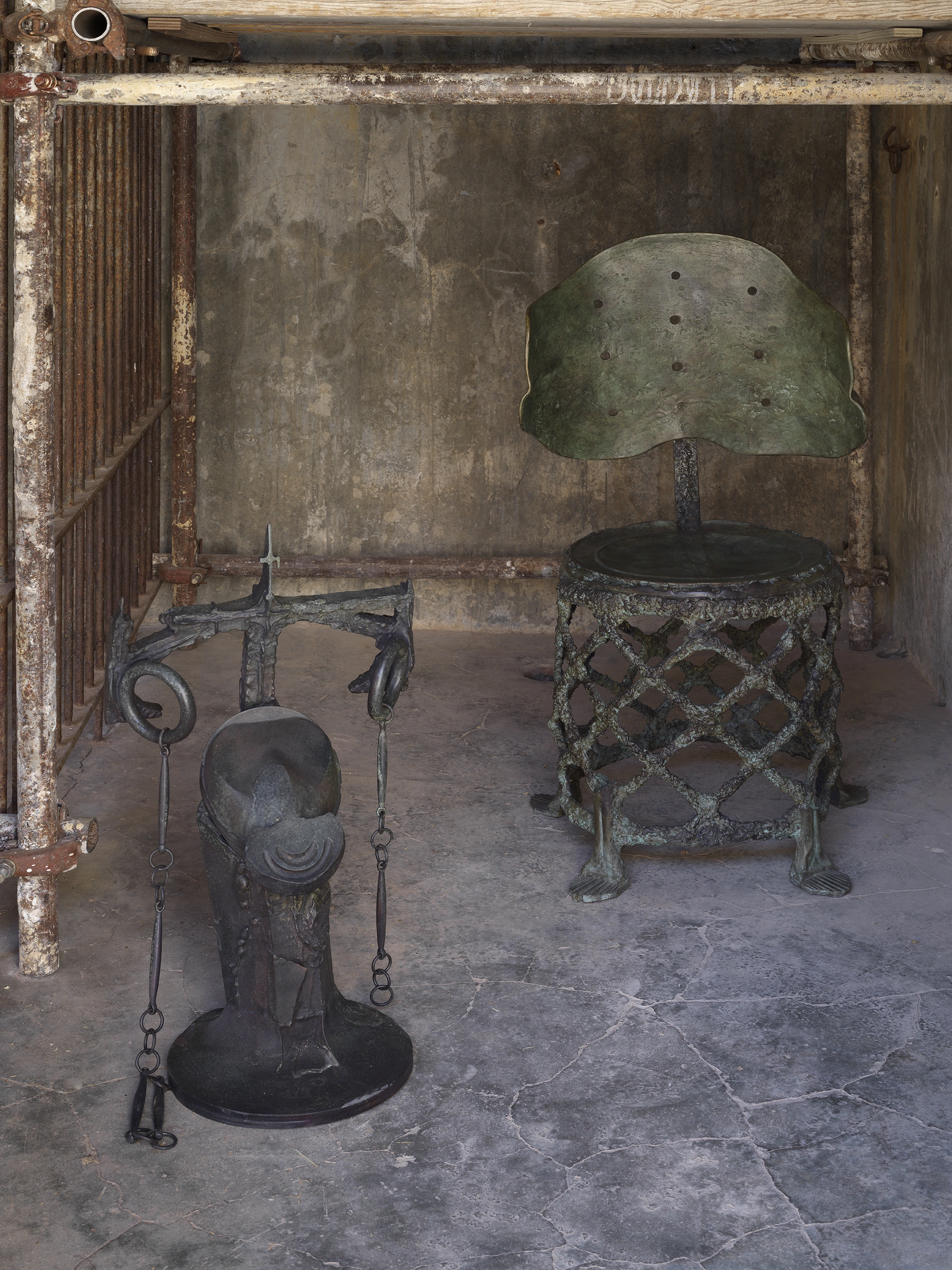
The second work, Doric Disorder, is a bronze shield covered with snakes, a reference to the Gorgon Medusa, whose head Perseus famously used as a shield. The title can be interpreted as a disruption of classical order, an undermining of the canon, a derailment of thought.
In the second cell there is a bronze sculpture. The legs of a skeleton are detached from its upper body, frozen in place by an invisible terror—perhaps the result of radiation. On the shelf above is the overturned bronze portrait of a man dying in agony. The archaeological-criminalistic character of these two sculptures is interrupted by an ethnographic work—a female torso with a prominent necklace falling over conical breasts, an archaic figure that could just as well come from Romania, Greece, or North Africa.
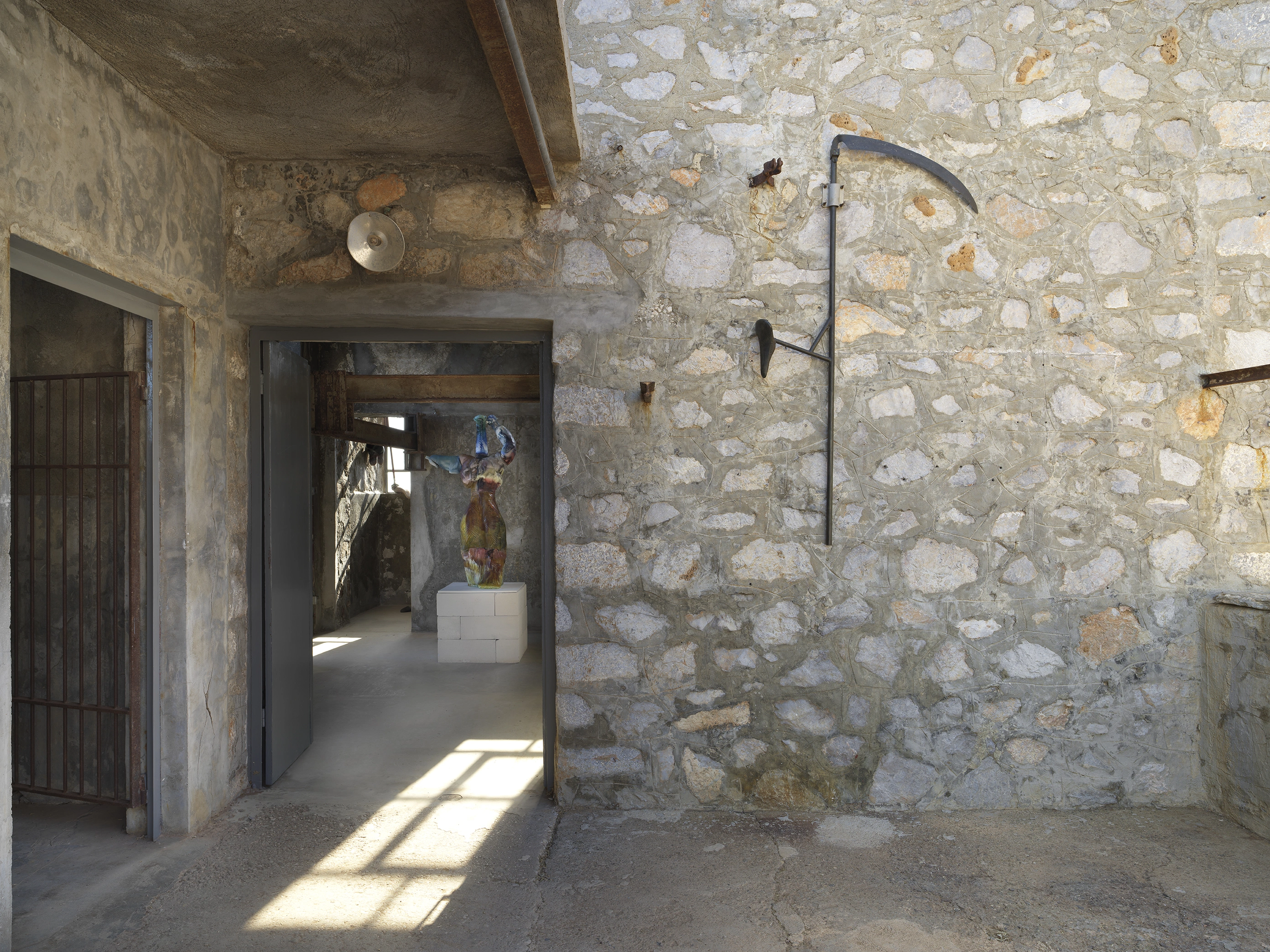
Before actually entering the slaughterhouse, we are informed by a scythe on the wall—with a bicycle seat attached to the handle—that someone has crossed the River Styx.
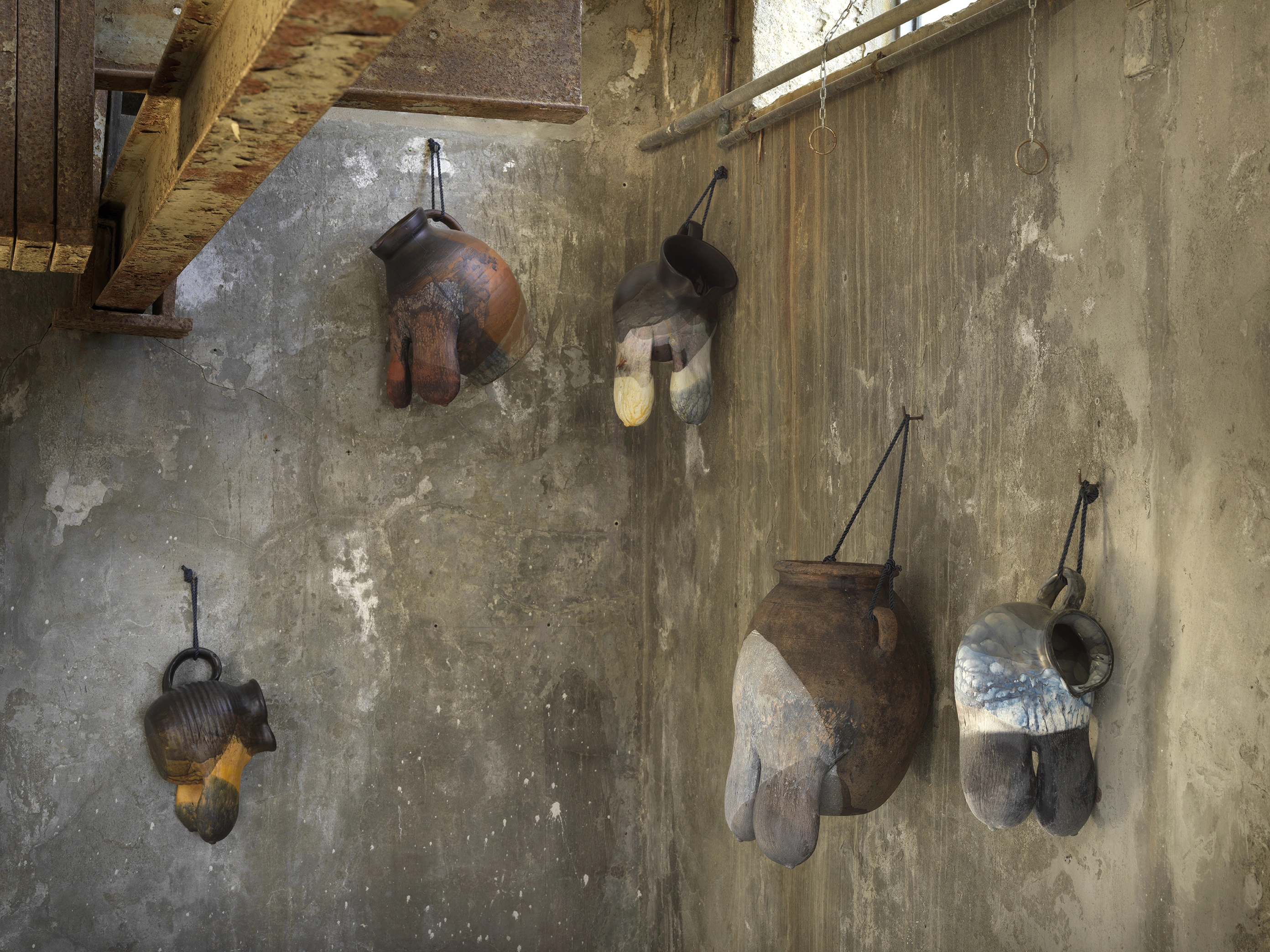
Clay pots with breasts are hung on the walls of the slaughterhouse, an installation called Atrophy Room. The pots contain oil and, like breasts, may also contain milk. They are carriers of life with stretch marks.
But the pièce de résistance is the Half-Drunk Mummy in its two versions: white and multicolored. The sculptures are made of glass, hollow inside, waiting to be filled with alcohol. Each figure is a hybrid of motifs from several eras: a dress from Ancient Egypt; the posture of a Minoan goddess with snakes; the stance of Classical Greece, one foot forward; and a head and neck shaped like a corset, reminiscent of a Cronenberg character. The body is subject to deformation. The flesh is textile or even plastic. An arm shaped like a water bottle. Clothes like the covering of a mummy. Together with the other constituent elements of the statues, their Egyptian clothing reflects what the artist explained at the cinema conference: Egyptian art was not only about the afterlife, but also aimed to give meaning to life here. The buttocks of the sculptures are not prominently displayed, which makes them "the opposite of Kim Kardashian," as one visitor to the exhibition remarked. They resemble, rather, the "legs" at the bottom of a thermally deformed plastic bottle, pushed inward.
The white work leaves room for the viewer to enjoy random shapes, patterns, and textures that can provoke various intracorporeal sensations. When you add to all this the spectacular colors, whose dynamics are complex to follow, the sculpture can only leave you with a complicated and pleasant memory. Both sculptures are made of recycled glass. The white one is marked by a small "accident" that betrays the process: a yellow stain on the folds of a leg, likely from a whiskey bottle. In the case of the colored sculpture, shards of different bottles fused in the kiln, yielding “precise-imprecise” results.
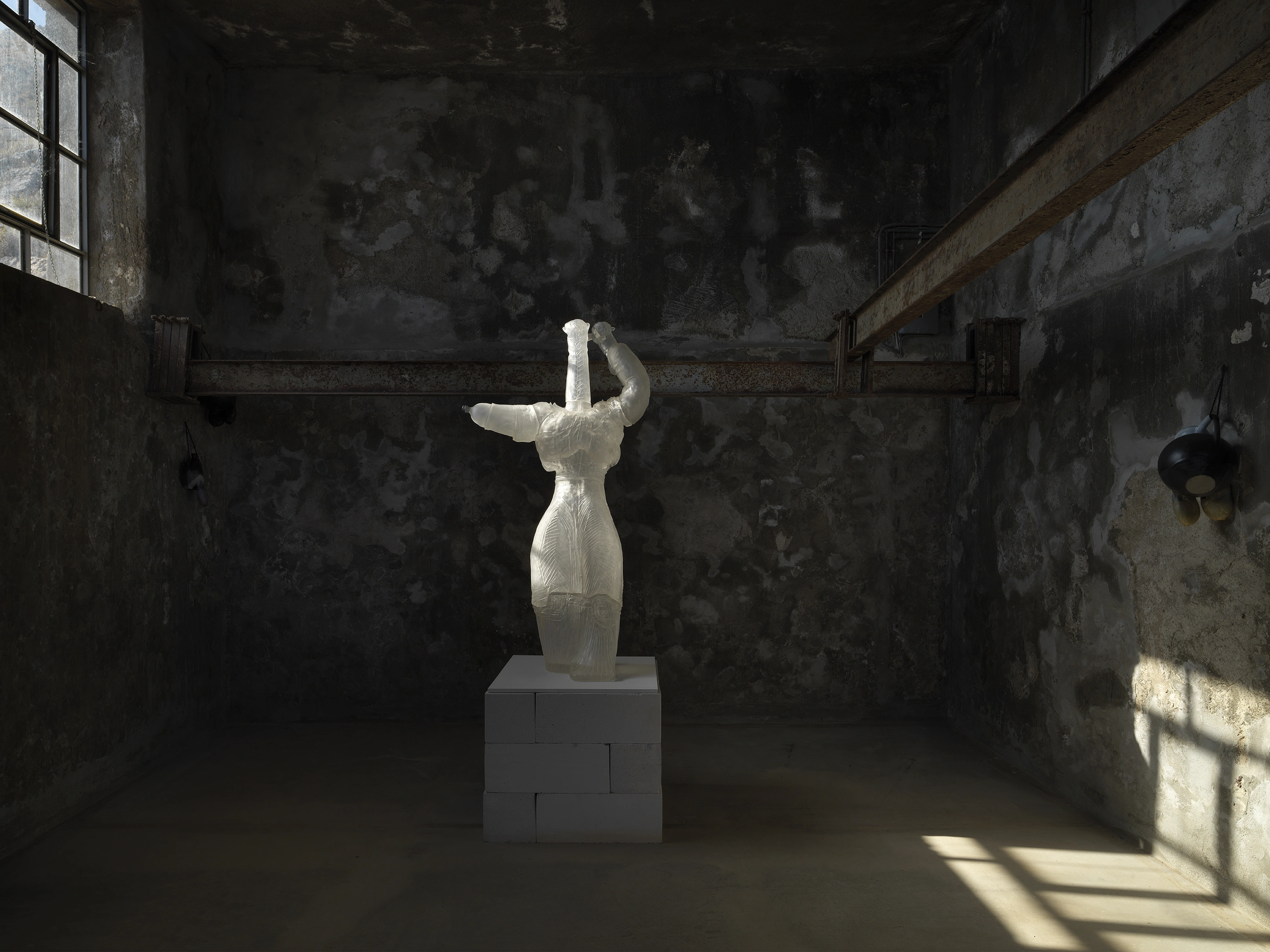
The two mummies seem to converse about how truth expands over long stretches of time and the fluctuations it experiences. The pair reminds us that although we currently perceive classical Greek sculptures as white, this is the result of the passage of time, as they were originally colored. The "white mummy" with an arm shaped like a bottle with a cap, pointing toward the wall, represents fixed ancient knowledge. The same arm of the "colored mummy" has no lid and points to the balcony of the slaughterhouse above the sea.
Although the works communicate harmoniously with the space, the atmosphere is interrupted by a detail that, as useful as it is for visitors and custodians, is just as annoying for the whole ensemble: a large and ugly air conditioner. With a little more effort, it could have been concealed, integrated chromatically into the space, or replaced with another type of ventilation system. I have seen similar details in the public exhibition spaces of collectors and patrons in Romania and other countries: cheap construction materials or simply unfortunate design solutions coexist with a space filled with art. It looks cheap. And it makes you think that if they skimped on making the space look good, they're probably skimping on the remuneration too. So much smattering and it still looks cheap.
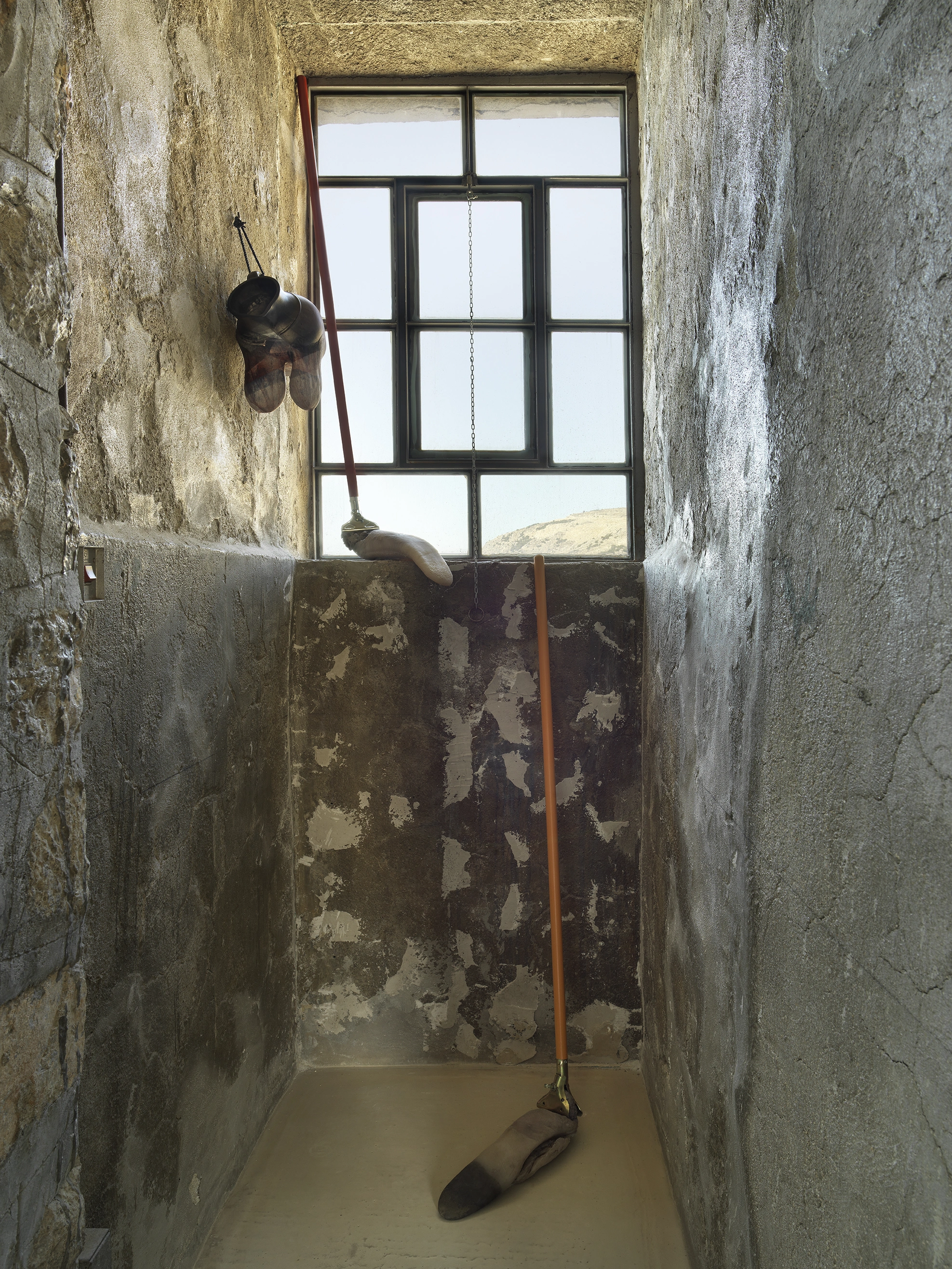
The slaughterhouse also conceals a small inner room with a view of the coast, where Ursuța becomes ironic. Continuing the discussion about “what keeps us alive,” the artist introduces a “bowl of breasts” alongside two other sculptures entitled Floor Lickers – silicone tongues attached to a broomstick. You are invited to touch the tongues, and the sensation is unique. The work speaks of sexual pleasure and objectification: of the other’s body, or parts of it, which can be used and reused until dehumanized, reduced to an instrument for someone else’s gratification. Placed in the context of the art world parading on Hydra, the work also speaks about the instrumentalization of others beyond sexuality. People can be treated as “tools” for one’s own purposes: for pleasure, entertainment, comfort, status, networking, obtaining something, or—even more insidiously—being rejected for their perceived uselessness. You are always the subject, and the others are always lickers who stimulate the “erogenous zones” of your own ego.
*
Naturally, time on the island became more relaxed as the art week progressed, each day marked by a spectacular yet subtly different sunset. And people became more open. Curator and author Ekaterina Juskowky tells me something I largely agree with: “When I first came to Hydra, I did so without any goal in mind, for the sake of the process, alongside beautiful people, in a beautiful landscape, where we could express ourselves and see what would happen next.”
She was in charge of the exhibition hosted by the island’s high school, Lithos/Lethe (Stone/Forgetfulness), curated by Dimitris Antonitsis and supported by Gagosian. She also oversaw the “salon” held that week at the Old Carpet Factory, a point of support through the routine it created, attended by polite and curious people.
*
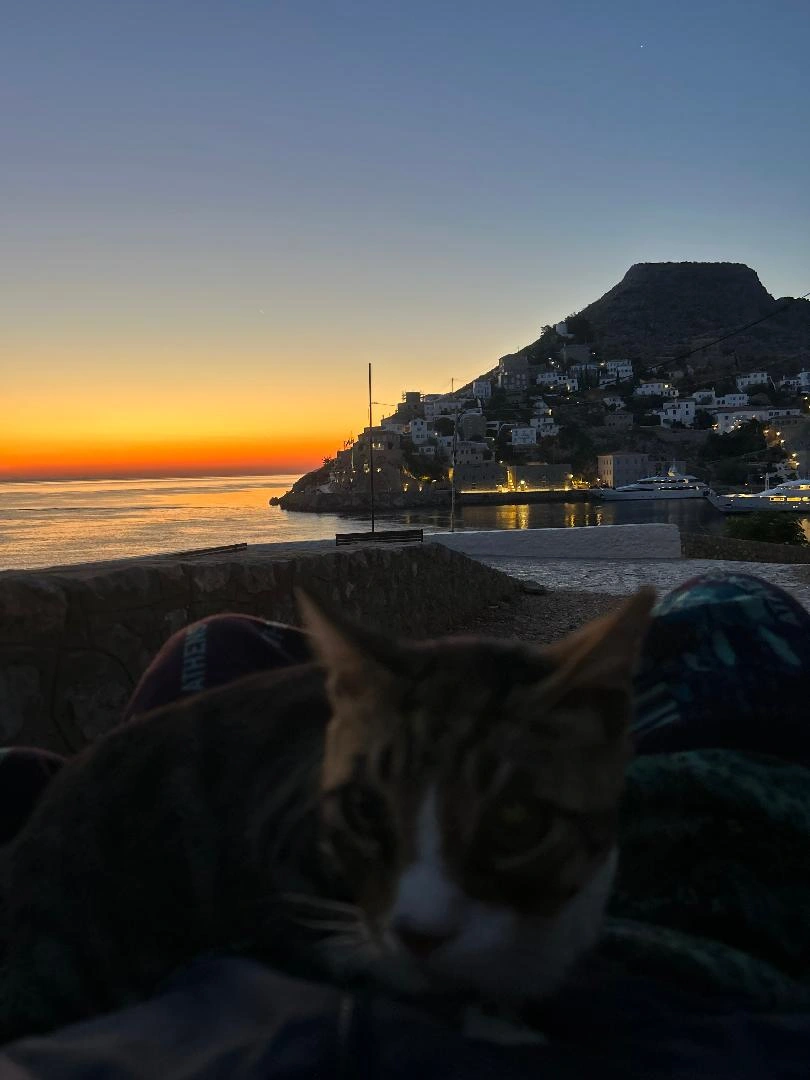
On the first night, I slept on the beach. Out of nowhere, just as I closed my eyes, a cat curled up against me and wouldn’t leave. Early in the morning, when the first swimmers arrived, I moved from the beach to a nearby cart. The cat followed and nestled into me again. It watched the sunrise from my arms. It seemed to want to show me that Hydra was welcoming — but in its own special way.
Main image: "Half-Drunk Mummy" (2024, leaded glass).
Photos by Dario Lasagni. Images courtesy of the exhibition organizers, unless otherwise noted.