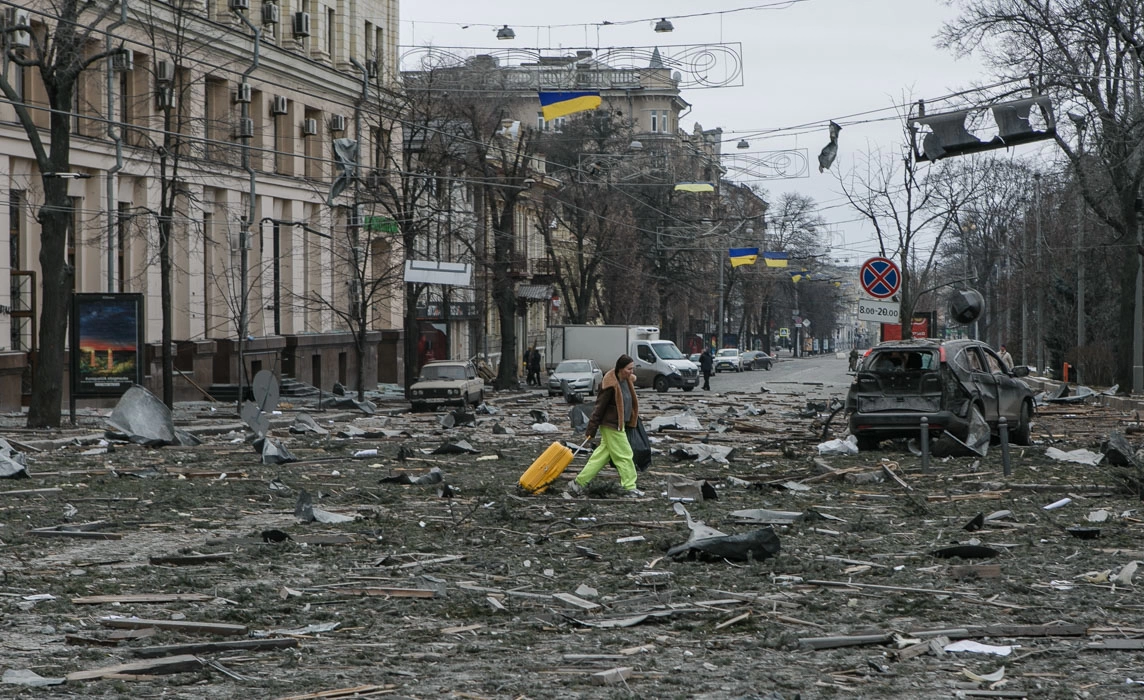
Ivan Mata and Fina Urpí are the architects behind Vaivera Arquitectura, a studio focused on cooperative housing in Catalonia, a model that emerged in response to Spain’s housing crisis and aims to slow down real estate speculation. Their work comes against a backdrop of growing social tensions where rents have skyrocketed. A recent example is the case of Maricarmen Abascal, an 87-year-old woman from Madrid who was evicted from the apartment she had lived in for 71 years after the building’s new owner tripled her rent. Her story became a symbol of the housing crisis, which brought hundreds of thousands of people onto the streets during several days of protests in major Spanish cities between September and November 2026.
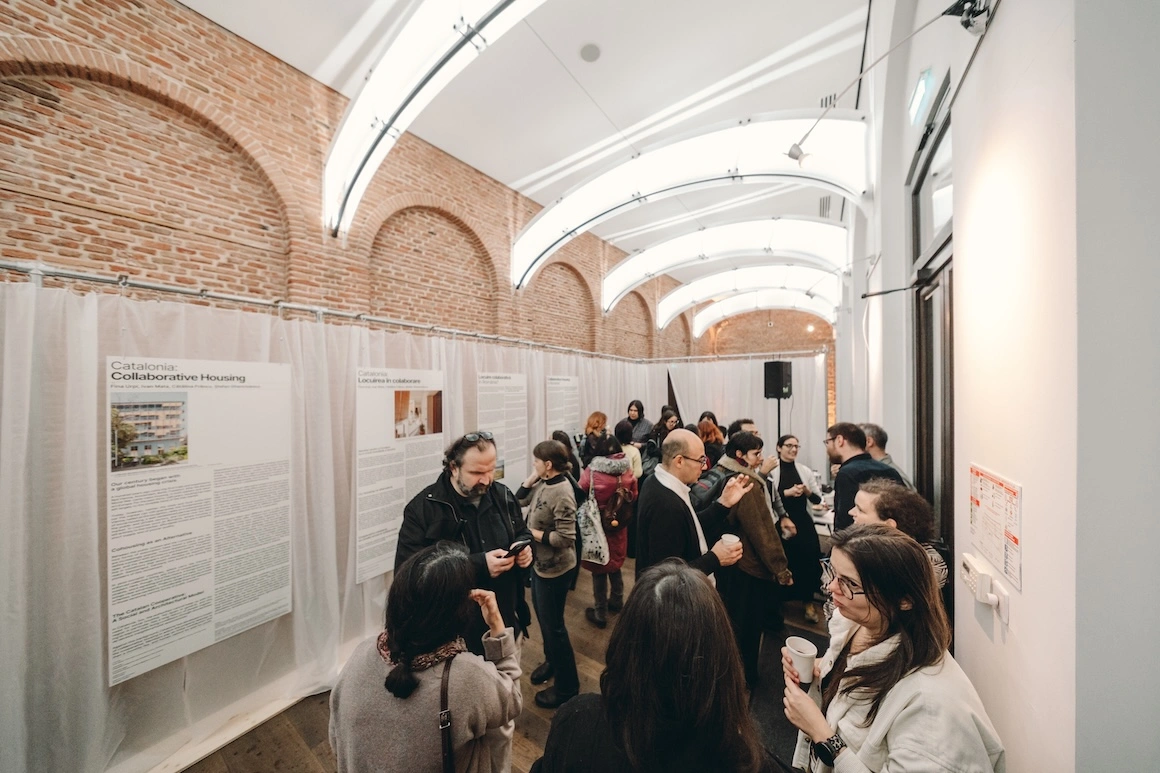
The Catalan duo visited Bucharest in early November to give a conference and attend the opening of the exhibition “Catalonia: Collaborative Housing”, part of the 13th edition of the UrbanEye Film Festival, dedicated to housing. The exhibition was co-curated by Vaivera Arquitectura together with Cătălina Frâncu and Ștefan Ghenciulescu and hosted at ARCUB. The four also co-edited a feature dossier of the same name in the latest print issue of Zeppelin magazine.
I met Ivan and Fina on a Wednesday morning at a café near Hotel Cișmigiu. It was their first time in Romania. We talked about how their architectural office came into being and about La Bastida – Pati del Gall, their cooperative housing development in Vilafranca, near Barcelona, where Fina is soon due to move. We also discussed the less visible aspects that make the catalan model of alternative housing possible: from securing land and financing to the ways people self-organize and collectively decide what their homes should look like, and how architecture can strengthen relationships between neighbors by creating more generous shared spaces. And, perhaps most importantly, we talked about how this model could be replicated, so that we can build not only affordable housing, but also communities where people feel less isolated from one another.
In a world where we organize our lives around individual ownership, how radical is the gesture of sharing with others?
*This interview has been edited for clarity and length.
S9: How did your relationship with architecture begin? Was there a particular moment when you knew this was the path you wanted to follow?
Fina Urpí: My family has no background in architecture. When I was little, I used to ask my mother what an architect was doing. She would explain that architects design houses, the places where people live, and that idea sparked my interest. I remember thinking, I'll study architecture, and then I'll see where it takes me and what I want to do.
Ivan Mata: I don't come from a family with an architectural background either. It wasn't really a conscious decision or something I had set out to achieve; it was more of an intuition. I don't think I ever explicitly told anyone that I wanted to become an architect, but when the time came to choose a university, around 90% of my options were related to architecture.
I think that when you come to architecture school without having been exposed to the architectural world, you don't really know what architecture is. You discover it gradually, and you realise that it is not quite what you had imagined. Instead, it opens up a completely different way of looking at and interpreting the world. I think that's what has kept us on this path.
How did you come to establish your own architectural practice together?
Ivan: I started working in my second year of architecture school. After that, I moved to Paris, where I continued working in architecture, initially through an Erasmus traineeship and later by collaborating with international firms. I spent 16 years in Paris. During that time, Fina and I also collaborated from time to time. Then we started working with the La Bastida cooperative on their collective housing project that took seven or eight years. And when the project finally reached a stage where it could be realised, it felt like the right moment for us to try to build up an architectural office.
Fina: We both went to Paris for Erasmus, but after returning to Barcelona, I joined a practice that also had an office there. Unlike Ivan, I have spent most of my life between the Vilafranca and Barcelona. The economic crisis had just begun, and being a mother made moving elsewhere particularly challenging, especially with the children. Since then, I have worked on various projects in Vilafranca, Barcelona and across Catalonia. This is where I feel most at home professionally, and where I have continued to work with Ivan.
Do you have a physical studio where you work together?
Ivan: That's a good question, because we actually started out working remotely. It was only about a year and a half ago, when I moved back to Barcelona, that we finally set up an office in the city centre. We share the space with a friend of ours, an architect from another generation, which makes it a very interesting environment to work in. We are surrounded by architectural models and documents, elements that have become increasingly rare in architecture studios, as physical models have been replaced by digital representations.
How do you split the work and how do you complete each other?
Fina: Ivan is very organised, but also very creative. I think that when you work alone, you tend to focus on certain aspects of a project, whereas working with someone else opens up more possibilities. Personally, some of my best projects have been the ones I've done with Ivan.
Ivan: Fina is very good at bringing things back down to earth. She knows when something is becoming too much and helps us find the right balance. She also brings a great deal of experience in construction. We both have extensive experience, but hers is very rooted in the local context. She understands how things work in the region and how to navigate the specific challenges that come with it.
I think there's an important connection between the way you work together and the kind of projects you develop, particularly cooperative housing. When you're working with others, you have to learn to make room for different perspectives, to step back and give the other person space. I feel like the collaboration within your practice follows a philosophy that's very similar to the one behind cooperative housing.
Ivan: Our collaboration didn't look like this from the beginning. When you move abroad, you don't necessarily imagine that you'll be away for so long. At first, you want to make the most of the experience. In my case, I would come back to Barcelona perhaps once or twice a year. But as time passes you become increasingly aware of the people and things you're missing. You think about your nephews, your mother getting older, and eventually you start coming back more often. The same thing happened with my collaboration with Fina. Working remotely was becoming increasingly demanding, especially when it came to coordinating the people involved in our projects, even though we were still a relatively small team. It simply became necessary to recognise that the time had come to make a change.
Your office is called Vaivera Arquitectura, a name rooted in the Catalan word vaivé, which describes a constant back-and-forth swing. What does this idea mean to you, and how does it translate in your work?
Ivan: It was important not to personalise the practice too much. In the end, an architecture office is defined by its projects and the work it produces. So rather than putting our names on the door, we wanted something that could express a certain spirit and leave room for the practice to become whatever it might eventually be.
For us, it also describes a movement that never really stops. Our own lives have involved moving back and forth between Paris, Vilafranca and Barcelona, and our projects often follow a similar pattern. There is always a sense of going somewhere and then returning, of moving between different places, ideas and ways of working.
We also wanted to give vaivé a feminine form, which is how we arrived at vaivera. We felt that this gave the name an additional dimension. It's important to us to work towards gender equality within the office. I think it's essential that our practice tries to reflect, in its own way, the kind of society we would like to see.
Cooperative housing in right of use is an alternative housing model that has been developed in Catalonia since 2004. It is based on collective ownership and individual rights of use. Instead of buying or renting a home on the open market, you join forces with other future residents to develop a building in which you will live.
The Catalan model (cesión de uso) is not unique. Similar forms of cooperative housing emerged in the 1960s and 1970s in Denmark (andelsbolig) and in Uruguay through FUCVAM cooperatives.
To become a member of the cooperative, you pay an initial refundable contribution, which makes it possible to start construction work, as well as a non-refundable monthly contribution intended to cover management and maintenance costs.
The building remains the property of the cooperative, while you benefit from a long-term right of use, generally ranging from 75 to 99 years when the building has been constructed on public land, with the possibility of extending the agreement.
You cannot sell the property or speculate on an increase in its value, because you do not hold individual ownership of the property itself, but only the right to use it. In other words, you own a right — the right to live there.
What did you know about Romania before being invited to co-curate the exhibition “Catalonia: Collaborative Living”, alongside Cătălina Frâncu and Ștefan Ghenciulescu, editors of the architecture magazine Zeppelin?
Ivan: It's our first time here in Romania. I’ve always wanted to explore this part of Europe, but I’ve never had the opportunity until now.
One of the first things I did when we arrived was take a photograph from our hotel window. I was struck by the contrast between two buildings standing very close to each other: a classical building, full of ornament, and a communist-era building, much more austere, with almost no decoration. You could read the different periods in their architecture, but also see how people had adapted and modified the buildings over time.
Fina: I remember saying how beautiful I find the city, even though sometimes, just behind one of its buildings, you would suddenly see a communist-era building, unfinished, without a roof. That contrast was quite striking in a good sense. Beyond the architecture, I also found the city very welcoming. I don't know how to explain it exactly, but there's something warm and approachable about the place and the people.
How did you come into contact with Zeppelin magazine?
Ivan: I was invited to lead a workshop in Paris as part of a European programme. For one week, the regular courses were suspended and guest lecturers from different countries were invited to teach around specific themes. Ștefan Ghenciulescu, architect and editor-in-chief of Zeppelin magazine, was also invited to take part in this workshop.
At the time, I was working on cooperative housing projects in Catalonia and Barcelona. I wanted the students to think about how a housing crisis, depending on its local context, could lead to very different architectural and social solutions.
The exercise was to ask each student to choose a place somewhere in the world and imagine what a housing crisis might look like there. The challenges in Southern Europe, for instance, are very different from those in Egypt. We wanted them to understand how these differences shape the possible responses. Ștefan was very interested in the subject, and that's how he eventually invited us to collaborate with Zeppelin and contribute to the magazine and the exhibition.
Your collaboration came at the time with the housing crisis becoming an increasingly urgent issue in Spain.
Ivan: The cooperative housing movement has been developing over many years, but its growth is not accidental. It responds to a real housing problem. Of course, the nature of that problem is different from what you might encounter in Romania, which is precisely why the local context matters.
One of the ambitions of cooperative housing is to develop models that can be multiplied and replicated. But replication doesn't mean simply copying the same project everywhere. These models need to be adapted to each particular context.
The solution we're developing in Catalonia might not be appropriate for Romania. However, the same tools and principles could help people here develop their own ways of responding to the housing challenges in Bucharest or other cities from Romania. That's also what I wanted the students to explore in the workshop: how to take an idea developed in one context and reinterpret it somewhere else.
So, in a way, what matters is understanding the underlying principles of cooperative housing and how the model works, and then adapting it to the specific social and urban context?
Fina: Exactly. In Barcelona, housing prices have risen so much that people who have lived in the city all their lives are being forced to move to the outskirts. The city has become increasingly oriented towards tourists and business interests, making it harder for local residents to remain here.
Cooperative housing starts with a very simple question: what is the problem we're facing, and what kind of solution do we want? In our case, people wanted to continue living in their own city, organise themselves, talk about their needs and, eventually, form a cooperative. That is the starting point.
Ivan: What we're proposing through cooperative housing is a different way of developing housing, particularly in contexts where there is a need for homes outside the speculative market. In Barcelona, the housing market has become increasingly driven by profit, and the returns people expect from housing speculation are enormous. We believe housing should not be treated as an object of speculation.
Can you name some examples of early cooperative housing projects in Barcelona?
Fina: One is La Borda (2012-2018), designed by Lacol Arquitectura, which has become a well-known example of cooperative housing. The other is Princesa 49 (2014-2018), a project by Sostre Cívic involving the renovation of an existing building in the city centre. Both emerged from the same process of people coming together and organising themselves around a shared goal.
Once people have formed a cooperative, they can start imagining a different way of living together. They can decide which spaces they want to share, how they want to use them and what kind of community they want to create. Architecture comes out of that process.
So it's a response to a collective need, but one that is also very specific to a particular neighbourhood, community and local context. It starts with a broader housing problem, but the solutions have to grow out of the actual needs of the people who live in that place.
Ivan: In Catalonia there's already a strong social network that allows people to organise themselves. These forms of collective organisation go back to the beginning of the 19th century and have survived through different periods of dictatorship. It's something quite deeply rooted in the local culture.
If you look at the benefits of these models, you might realise that they don't necessarily have to be associated with the particular image or understanding of collective living that you have in mind here in Romania. Perhaps the first step is to move beyond the vocabulary we use to describe these things. Romania might need to develop its own glossary, its own terms, in order to understand how these ideas could be incorporated into a different context and given a chance to become an alternative.
Fina: Collective housing also means having the power to decide together how you want your building to be designed, what materials you want to use and which spaces you want to share. There are so many decisions to be made, and they're taken democratically. Everyone has a vote and a voice in the discussion. We decide together what we want.
Ivan: Cooperative housing, collective housing, co-living – whatever terminology you choose – can take many different forms and exist at different scales. The important thing is to understand that you can start with a small group of people who want to live collectively, even if what they're doing isn't exactly the same model we're proposing.
Fina: Ultimately, it's about having a stable place to live, somewhere you can afford. Somewhere you can actually pay for. That's really what it comes down to. And I think there's another important aspect: we're coming from a society where individualism has reached a point at which many people feel increasingly isolated.
At La Bastida Cooperative, for example, there are people from different generations living together. Some older residents have told us that they don't necessarily want anything complicated. They simply want to feel accompanied, to know their neighbours, to have their friends nearby – to know that María is there, that Toni is there.
For me, it's also about rebuilding relationships between people. I grew up in a small village, where, when I was young, you would simply go out into the street, meet someone, sit together, get some fresh air and talk. People shared these everyday moments almost without thinking about it. That kind of life has gradually disappeared, and I think people are now looking to recover those relationships with their neighbours. They want to feel part of a community again.
I think cooperative housing also reflects a certain vision of how we choose to live. Not everyone wants to follow the traditional model of the heteronormative nuclear family. For some people, friendships and the families they build beyond biological ties are just as important. And this raises another question: what kind of community do we want to have around us as we grow older?
Ivan: That's actually one of the things cooperative housing tries to address: moving away from the idea that the standard household must be based on a traditional, heteronormative family unit. This is also reflected in the way we design the housing. We try to make the kitchen a more open and shared space, rather than a room where one person is expected to spend time, disconnected from the rest of the household's activities – whatever form that household or family might take.
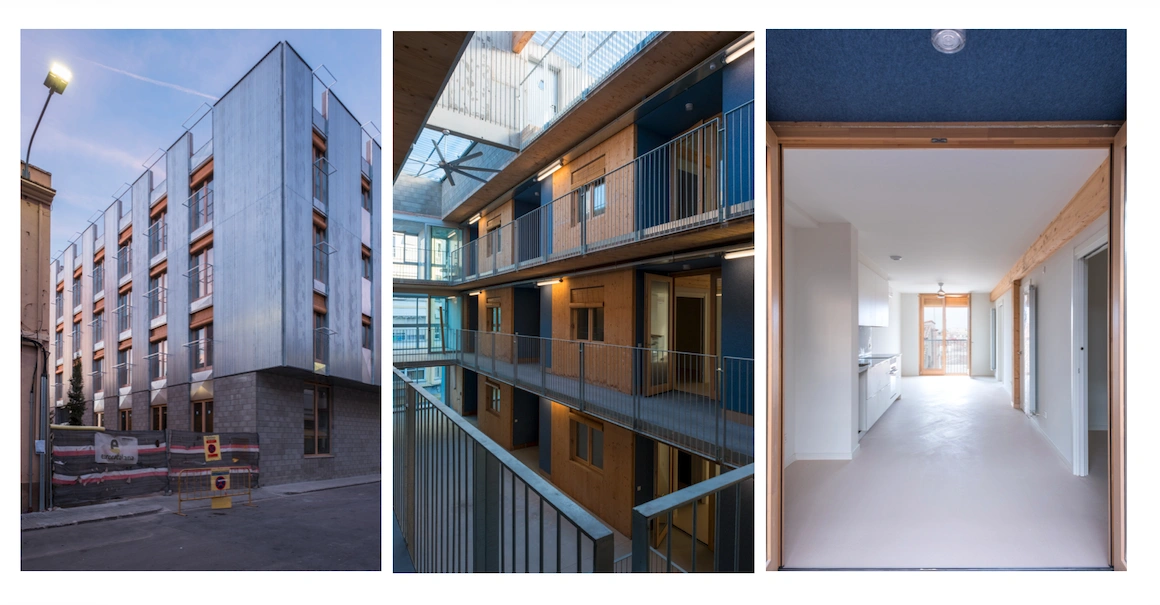
We also try to make the rooms equal or at least equivalent in size, so that there isn't necessarily a main bedroom and a secondary bedroom. This gives people more freedom to decide how they want to use the spaces. If you have one room of 18 square metres and another of just nine, you might actually be wasting space in the larger room while not having enough space in the smaller one for activities beyond sleeping. By making the rooms more equivalent, you allow for greater flexibility and different ways of living together.
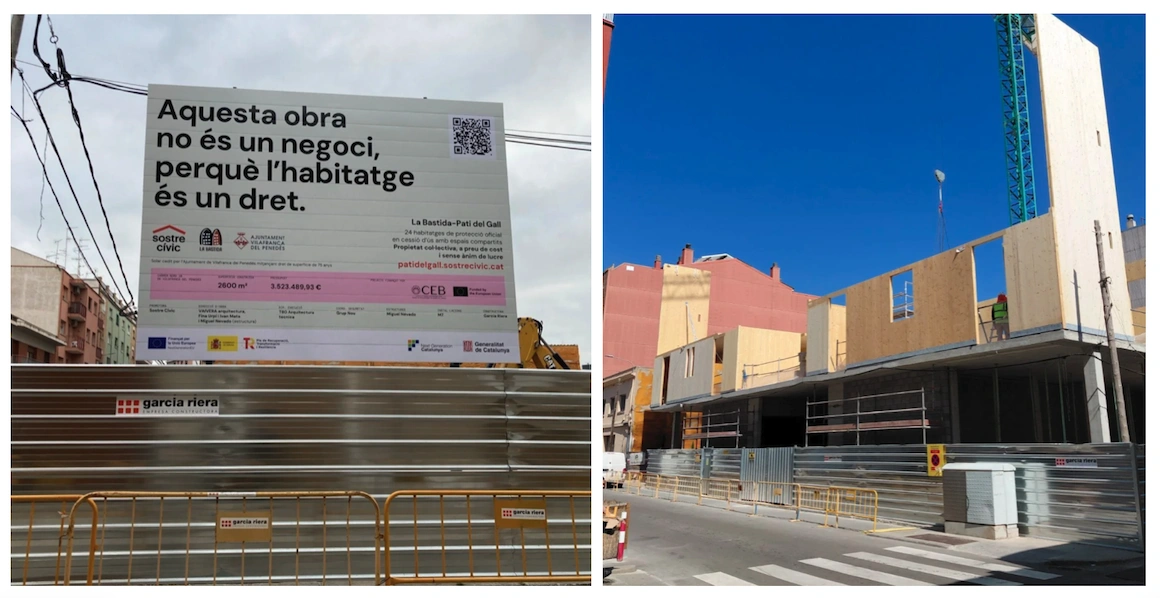
Could you tell me a little about your La Bastida – Pati del Gall project in Vilafranca, which is now nearing completion, eight years after the process began? What makes it unique, and what are its main defining features?
Ivan: La Bastida has one of the highest proportions of shared spaces among Sostre Cívic projects. We deliberately dedicated a significant amount of floor area to common spaces, while trying to keep the individual apartments as compact and efficient as possible.
We noticed that people often want a larger apartment because they might occasionally have their parents or a friend staying over. But that means maintaining extra space that remains unused most of the time.
So we asked ourselves: what if the 24 households in the building could share a small studio apartment of around 20 square metres, which they could book whenever they needed to accommodate a guest?
Another approach, quite common in this type of housing, is to turn circulation areas into places where people can meet and interact, rather than treating corridors and shared access spaces as purely functional.
One of the most important common spaces is the multipurpose room. An essential part of cooperative housing is that residents meet regularly, perhaps once a month, to discuss how things are going and make decisions together. They also organise themselves into different committees, each responsible for a particular aspect of the building, such as the management and maintenance of the common spaces, taking care of the garden and so on. Everyone contributes in some way.
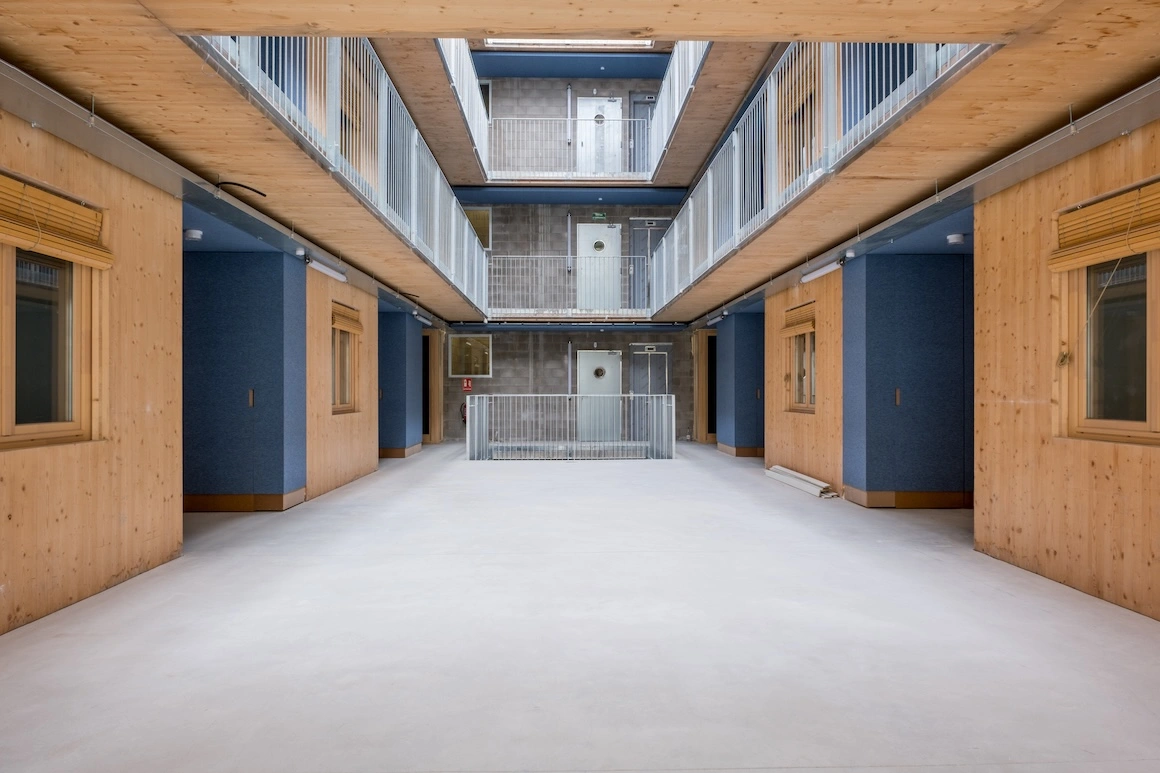
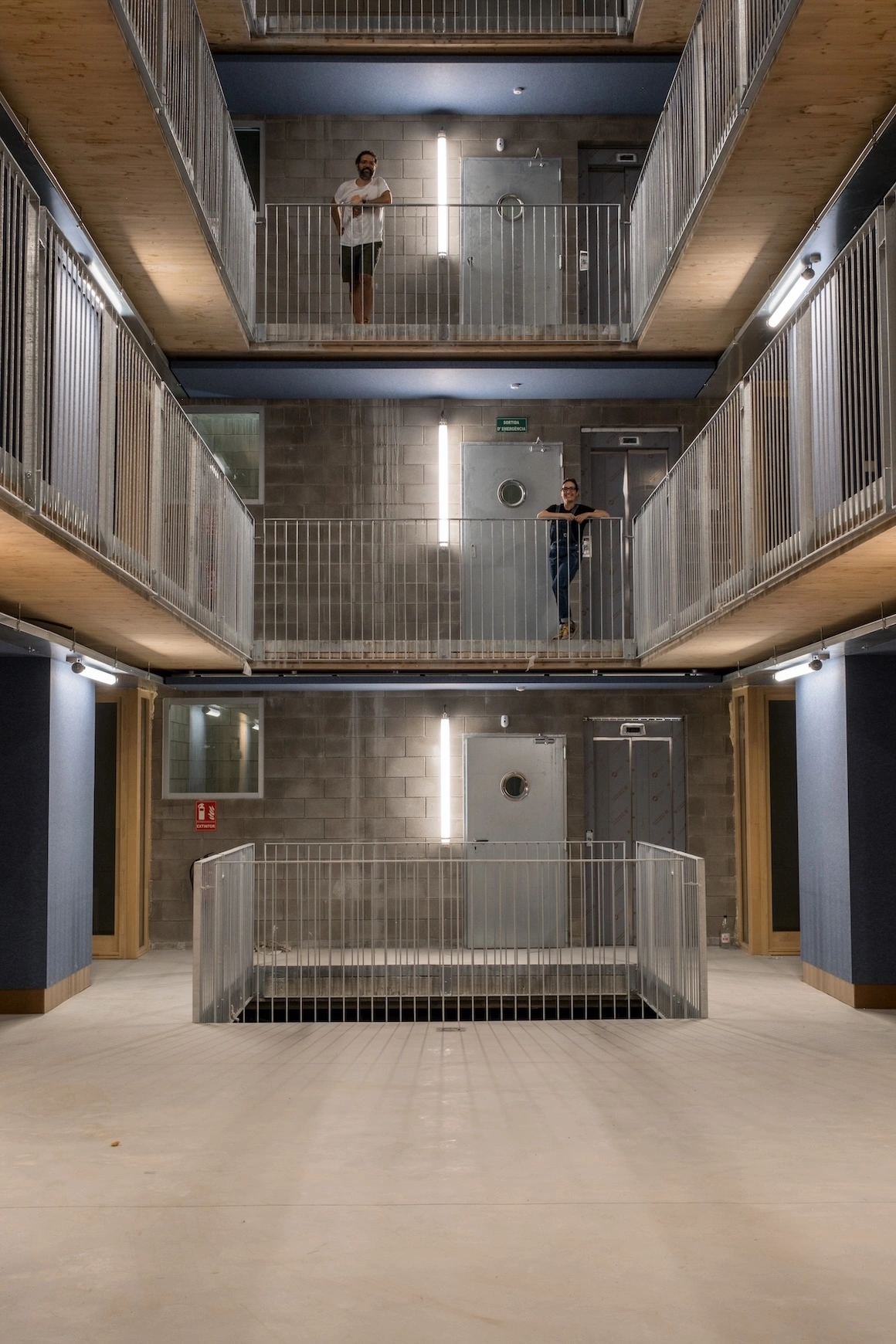
Fina: We couldn't provide individual outdoor balconies because we wanted to use that volume to increase the living space inside the apartments. Instead, we designed a bioclimatic atrium around the circulation areas. It's a large space that works almost like an elevated village street. The residents on the first floor share this generous common space, while the upper floors have corridors. But even there, we've made the entrance areas wider, giving each apartment a kind of balcony opening onto the atrium. It's a space with a controlled indoor climate, where people can spend time and interact.
The idea is that when you see someone going into their apartment, you can stop and ask: How are you? What have you been doing today? What are you cooking? These small, everyday interactions are important. They allow people to look after one another and help prevent older residents, in particular, from becoming isolated. In a way, we're trying to increase the opportunities for social interaction, to create more chances for people to meet naturally as part of their everyday lives.
Did people know each other before the project began, or did the community come together through the process of developing the building?
Fina: We began as four living units rather than four families, because we didn't want to define people exclusively through the traditional idea of family. For example, my unit consists of me and my two children. Another is a couple with three children, while another is made up of a single person. There are also two friends who decided to join and live together.
The building didn't come first. It was the other way around. We started by saying: We want to live together. So, where could we do that? We needed to find a plot of land.
In our case, we had to explain to the local authorities what cooperative housing actually meant, because it was still a relatively new concept and not very well known.
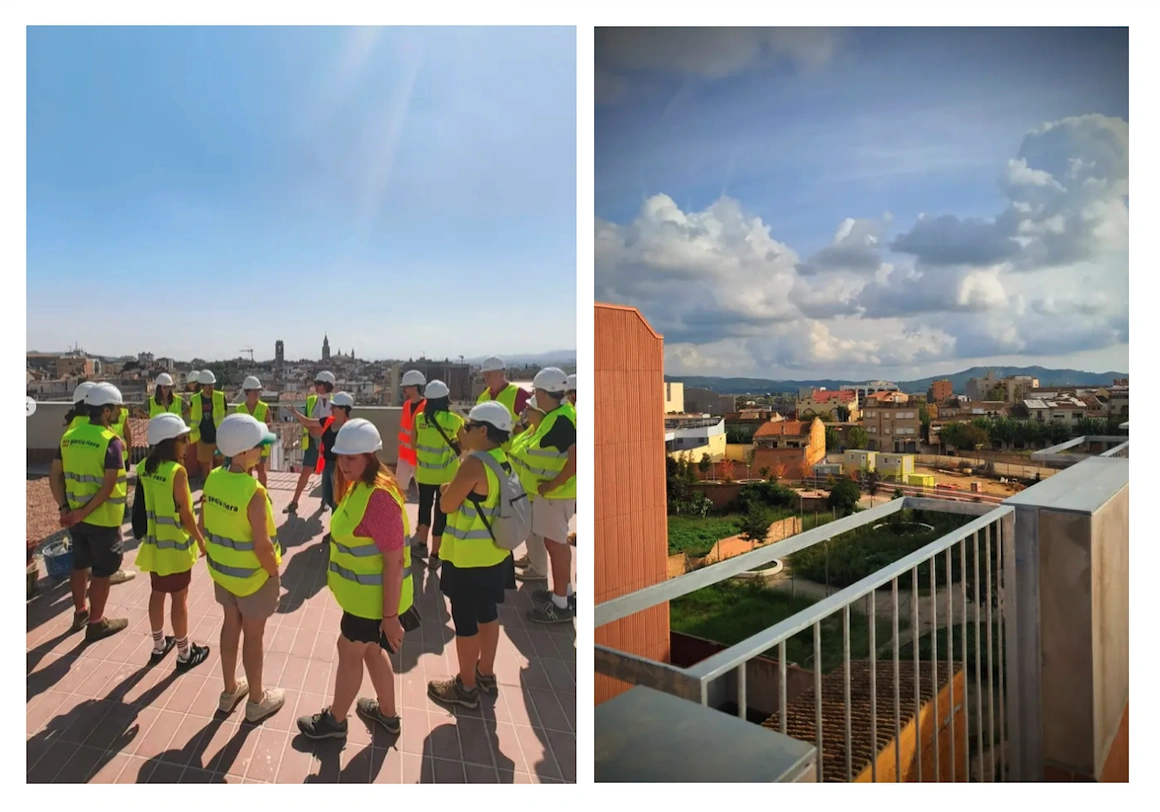
The plot where the building now stands belonged to the municipality, which had an obligation to provide social housing. The municipality made the land available to the cooperative, while the cooperative took responsibility for financing the construction of the building. From that moment on, we started meeting regularly, usually once a month, or more often whenever the process required it. We gradually developed the project together, making decisions and organising ourselves as a group.
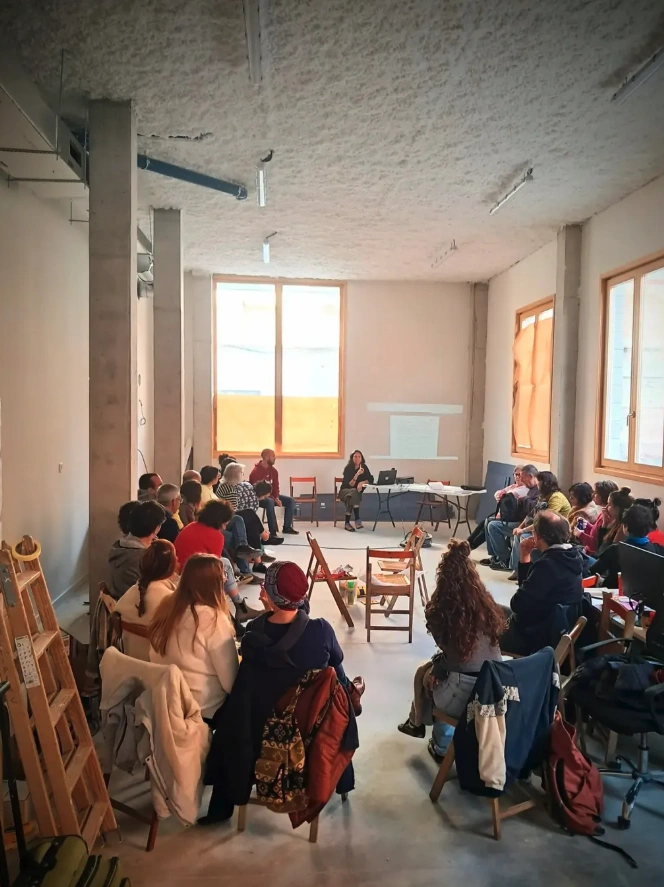
Ivan: The housing cooperative is showing new ways of living. Organisations such as INCASÒL, which are involved in the development of social housing in Catalonia, are beginning to incorporate concepts such as shared spaces and residential clusters into their projects. But that doesn't mean that an entire building should be organised around one model. Some people might prefer to live in a more closely connected cluster, sharing more aspects of their everyday lives, while others might want to maintain a greater degree of privacy and only share a few common spaces. We need to understand that everyone has a different approach to living collectively. People have different ideas about what they want to share, how much of their lives they want to make visible to others and how involved they want to be in the community. The important thing is to make room for these different ways of living.
What are the biggest obstacles to developing cooperative housing?
Ivan: Once you've brought a group of people together, the first major challenge is finding a site. With La Bastida, this came even before securing financing. If you want to make housing affordable, you need to reduce construction costs as much as possible. Having access to publicly owned land, through a long-term right of use – sometimes for 75 or even 100 years – makes a significant difference.
This is where organisations such as Sostre Cívic and La Dinamo become important. They provide legal, financial and administrative support to groups who want to establish their own cooperatives. They make it possible for people to organise themselves and develop projects without having to manage all the complexity on their own.
What is the situation right now in Barcelona?
Ivan: Barcelona has had restrictions on tourist rental licences for individual apartments for 10-12 years now. During Ada Colau's time as mayor, there was a strong political commitment to finding ways to address rising housing prices.
When foreign investors try to buy entire buildings, often with the intention of turning them into tourist accommodation, the city council can sometimes exercise its right to acquire the property for public interest and transform it into cooperative housing. It's another way of increasing the city's stock of affordable housing.
However, entire buildings can still be acquired for this purpose, which has created another kind of pressure on the housing market. Investors buying buildings can also displace long-term tenants, and this has led to various social movements resisting evictions.
Cooperative housing offers an alternative because it takes properties out of the speculative market. The more cooperatives we have, the greater their potential to act as a counterbalance to the market, allowing people to have stable homes at relatively affordable costs.
I think this is why we've been talking about a kind of spring of cooperative housing in Catalonia. There was already a strong network of social organisations, a tradition of collective organisation and, importantly, a political context that allowed these initiatives to develop.
Looking 20 or 30 years ahead, what change would you hope your projects have brought about in how people live together, within their communities and beyond?
Fina: I think the main objective of La Bastida is to make this model replicable. We also need to keep learning from these projects, looking at how people live in them and how we can improve them. There's always room for improvement. Access to housing has become so difficult that I think many people are interested in this model simply because it offers the possibility of having a stable, affordable home.
Ivan: For me, it's all about replication. Barcelona has less than 5% social housing, whereas in Vienna the figure is around 40%. That's one of the reasons the city has more capacity to influence and stabilize housing prices.
In Spain, social housing was built for many years, but it was often sold rather than kept in public ownership. After a certain period, people could sell those apartments on the open market, and they eventually became part of the speculative housing market again. The key, then, is to create housing that cannot simply be resold for profit. Cooperative housing works on this principle: residents have the right to live there, but they cannot speculate on the property or sell the home (author’s note: residents hold the right of use, rather than ownership of the property itself).
But there's another important aspect we haven't discussed: when people come together to develop their own housing, they can also choose different priorities. They're no longer guided exclusively by economic efficiency. They can focus on environmental performance, for example, and build differently, with the aim of reducing the carbon footprint of construction.