

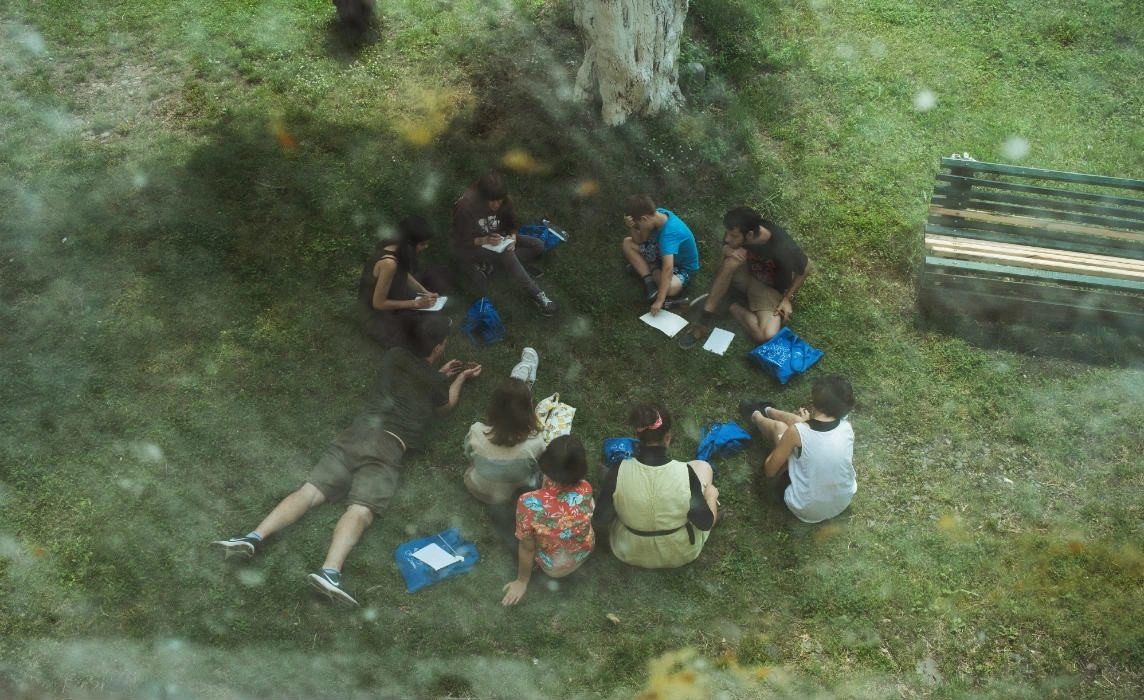
I spoke with Aurora Mititelu, a Romania-born, US-based young experimental artist, about control and identity in her work, what it means to be a woman in a male-dominated environment, and what it's like to start over thousands of kilometers away from home.
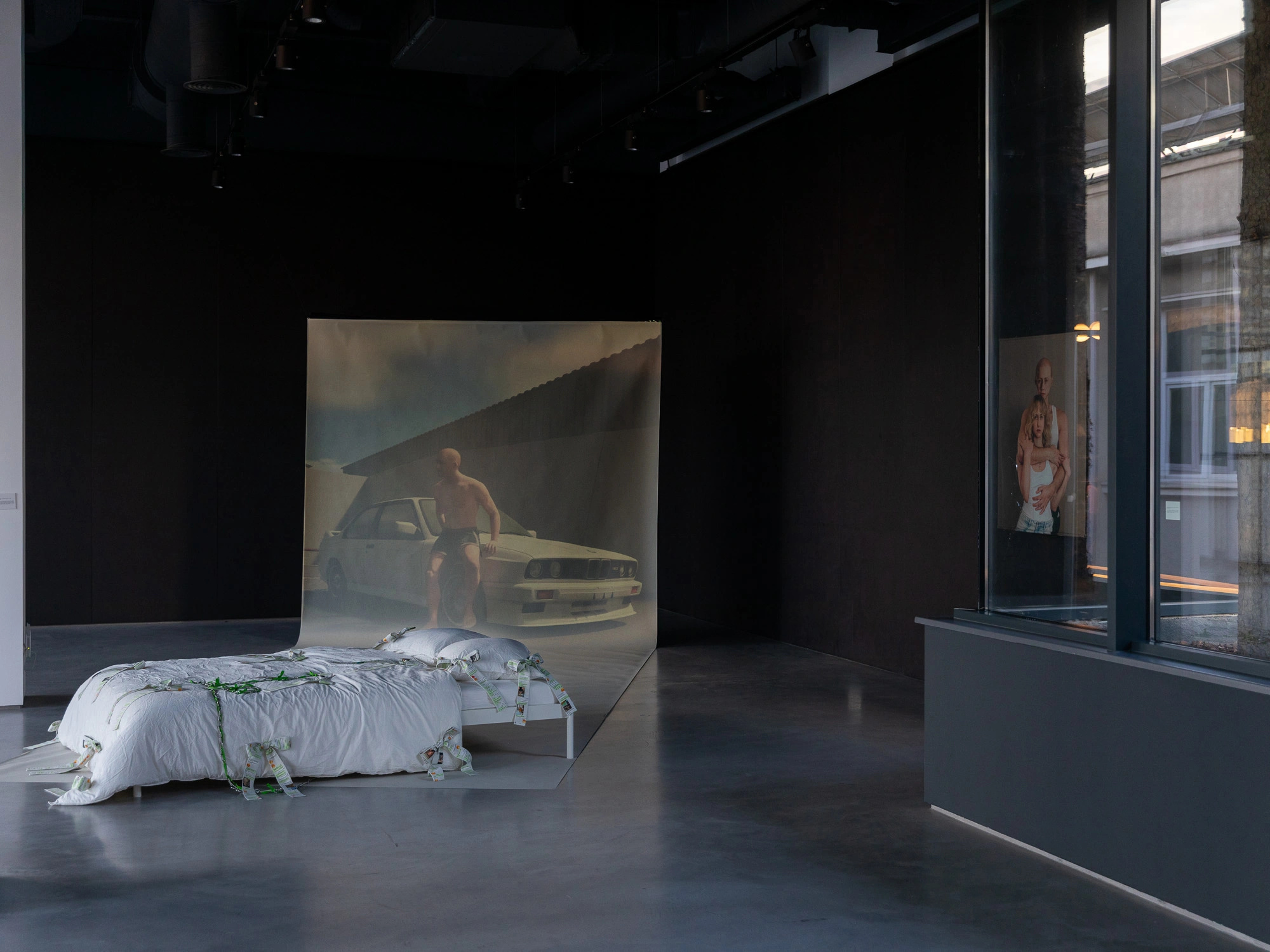
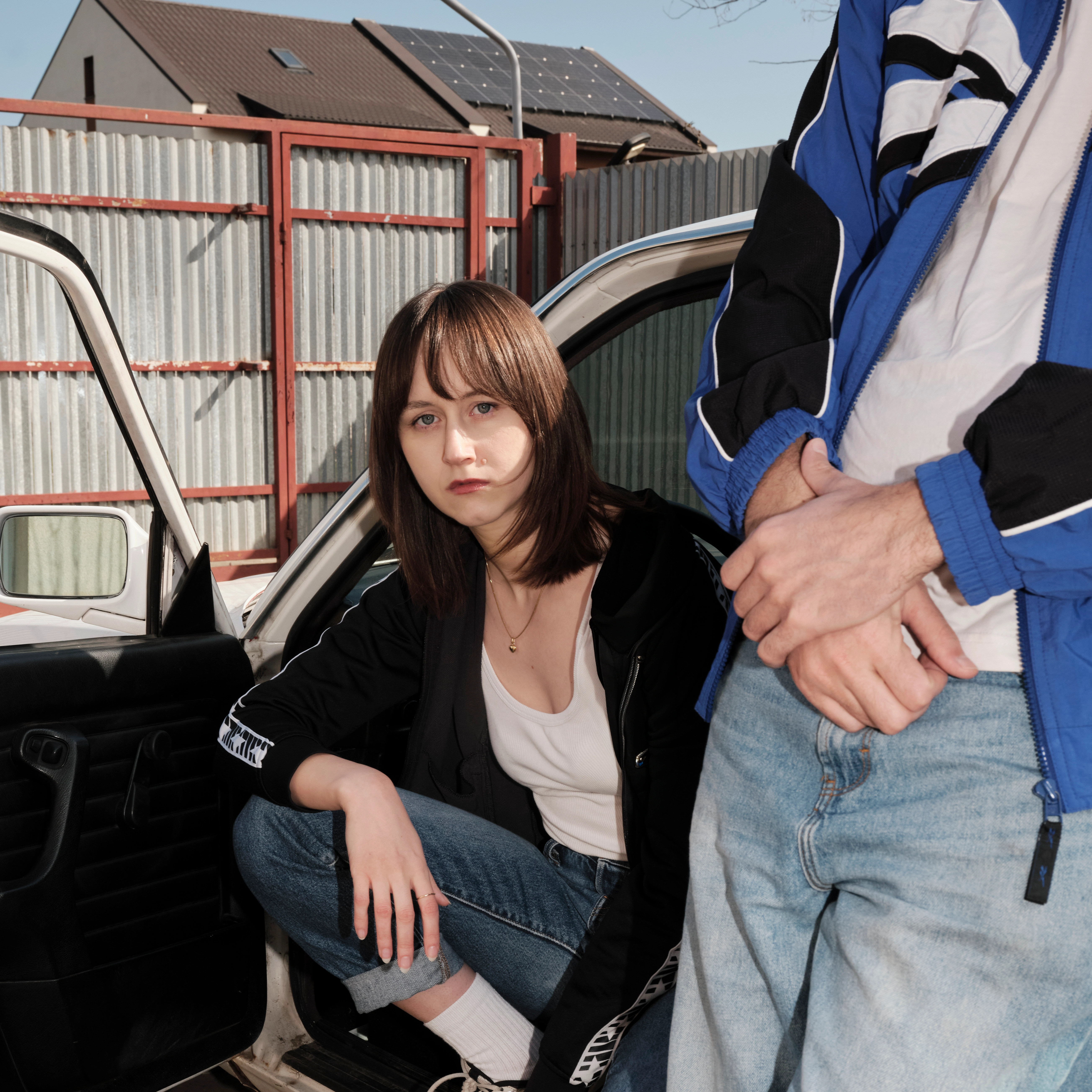
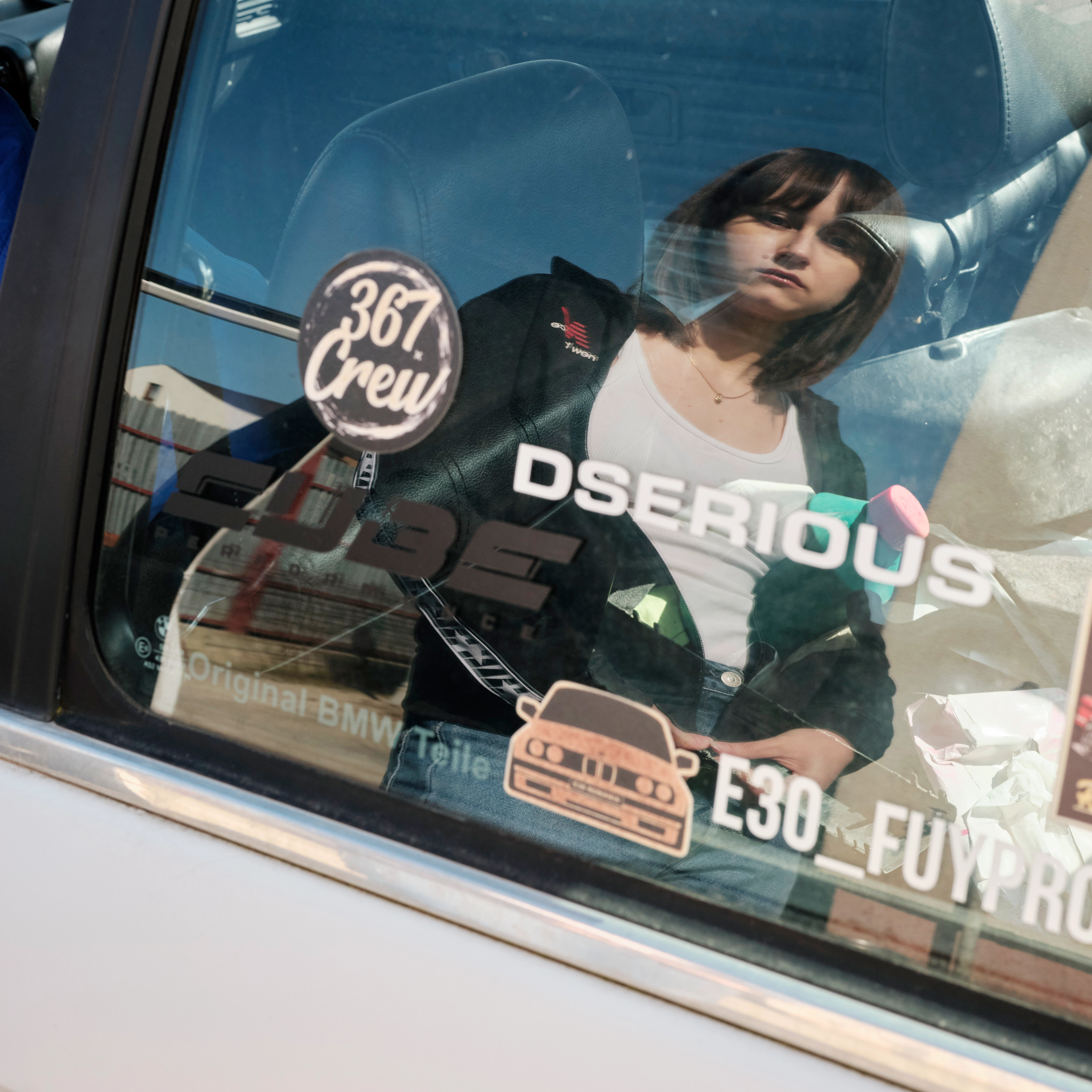
Aurora sits on a bedroom bed with her legs crossed, phone in hand. She’s texting Abel, her boyfriend, whom you can see projected in an image behind her. On the bedsheet, there are also several large ribbons, some shaped like bows, bearing a mix of excerpts from her message archive, and others AI-generated. In another image, Abel embraces Aurora and they seem almost intertwined. They're both in white tank tops and a golden cross pendant glows at Aurora’s neck. Their faces look nearly identical: blue eyes, the way they hold their lips slightly parted, and even an identically positioned mole. In one image, Abel manspreads, highlighting his flip-flops, rings, and the apartment blocks in the background. He stands on a carpet similar to those that adorned the homes of many of us Romanians in the early 2000s.
“There’s this whole pattern [in art] where a man creates an image of a woman. It’s actually an age-old history. And then the question emerges: who's representing whom? In what way, and how, when you create a female avatar, do you actually have a certain kind of control over her body, over what she looks like, how she moves, what poses she appears in?”, the artist explains in a café in Bucharest.
Abel is the male avatar Aurora created in 2023 using CGI and artificial intelligence, as an extension of herself, in an act of reclaiming autonomy as a woman brought up in a heteronormative environment.

Mititelu, 31, is an experimental artist. She's also the coordinator of the AI & Art Summer Institute program at UCLA Social Software. She left Romania in 2017 after graduating in graphic design from UNARTE, yet her art still carries the strong influence of the environment she hails from. She is drawn to chaos and the absence of clear structures, in contrast with the milieus she lived in after emigrating. When we first met in Bucharest, on a snowy day in early 2026, I couldn’t stop complaining about the city, while she seemed to hold it under a different gaze—one imbued with a kind of curiosity I sometimes miss, which made me pay more attention to my surroundings.
We spoke sitting on the bed that was part of her installation, on display at Bucharest's Strata Gallery, about her art and how concepts such as control and identity emerge in it, about what it means to be a woman in a male-dominated field, and about starting your life over, thousands of kilometers away from home.
Pop Culture, Icons, and Art
One of the first ever images I saw of Aurora was a photograph from 2005, where the artist, then aged 10, sits in front of a computer. The screen shows highly detailed Paint drawings of a witch and a rabbit. How did she make those drawings, what was the story behind that photo? Laughing, she told me it was taken in Buzău, southeastern Romania, at the Children’s Palace, which she used to attend with her sister Amalia, in order to draw in Paint before they had a home computer. Nobody really taught them how the software worked. The instructors were barely able to do more than open the applications. But she and her sister experimented on their own. They played with gradients, drew constantly, and learned the tools intuitively.
At the time, the girls played Diner Dash, a video game where you manage a restaurant, and experimented with the characters. Aurora was fascinated with the idea of customizing the characters' looks to her heart's content—perhaps one of her very first moments of exploring what it meant to create and control an identity.
Aged seven, she received her first computer from a neighbor who had bought a new one and wanted to get rid of the old machine. Aurora watched anime, followed pop artists, and gradually immersed herself more and more in the digital world within which she longed to create. We both grew up in the 2000s and share somewhat similar references. She was inspired by Miley Cyrus and Hannah Montana, even if the character confused her, because she was fascinated by how she was constructed.
“I really loved musical artists in general, but not necessarily just for the music—it was the way they built an identity through posters, music videos, album covers, and the whole visual universe surrounding them. I think what fascinated me, even if I couldn’t articulate it back then, was the idea of personality and identity constructed through media and art.”
Her sister Amalia became (and remains) her creative partner. They started drawing together at age five, on paper, and continue to this day. Amalia is now pursuing a film master’s degree in Chicago, and they still constantly talk on the phone about their ideas, the works they want to create, and the processes behind them.
“It feels amazing to have someone with the a shared sensitivity, someone who understands you so well. Because, sometimes, neither for her nor for me do people fully understand what we do,” the artist continues. “But it’s very valuable to have someone who can say: ‘I know exactly what you mean.’ It’s like a shared universe.”
Their parents are engineers, but they sent both daughters to art school from first grade onward. Looking back now, Aurora realizes it was a brave decision.
“They spent their last money on us and said, ‘It doesn’t matter. It’s important for the girls!’”
That’s also how they got their first graphic tablet, even though their parents couldn’t really afford it. The girls used it constantly; it became essential. She shared it with her sister, negotiating whose turn it was to use it.
When Aurora started school, a kind of rupture emerged between the world she lived in at home or on the computer and what she learned in class. She did not study conceptual art, not even in high school. Instead, she painted in a traditional style and created religious icons. Students learned mostly through imitation. There was also a practical component where they prepared their materials manually: mixing bone glue with chalk powder for primer, working with layers and pigments.
“Now that I think about it, it almost feels like witchcraft,” the artist recalls laughing.
Meanwhile, Aurora dreamed of working in Photoshop instead of painting icons. Neither she nor her family were religious, so icon painting held no ritual or spiritual meaning for her.
“It felt like I was contributing to something completely disconnected from my reality. My world was entirely different: American media, television, games, computers, the internet, messages—a totally separate universe.”
When they finally started discussing modernism in school, she remembers teachers referring to that historical period as the moment when “art was ruined.” Only later did she realize how these gaps in her formal education slowed her understanding of contemporary art—she lacked the necessary context and tools to fully grasp it.
At the same time, she competed in IT Olympiads because she wanted to learn more about computers. She knew how to make PowerPoint animations and use Photoshop, she designed her high school’s logo —which remains unchanged to this day—and took a summer job at a local newspaper in her hometown of Buzău, where she learned what it takes to create a newspaper from scratch.
“Good job, girl!”
At university, in graphic design, she was the first to get in and remembers it as one of the moments when she told herself, “Good job, girl!”
She thought graphic design was the closest thing to making art on a computer, but along the way she realized what was being taught had little to do with what she wanted to do.
“I think there was a kind of misalignment between what I wanted and what the university offered. I had classmates who were incredibly passionate about graphic design and deeply invested in the whole process. For them it was an entire world to discover: layout, systems, structure. For me, those things passed by quickly—I’d do them and move on. I didn’t necessarily feel that strong desire to build a book or a system from scratch, for example.”
Her direction became a little clearer after she attended the Worksheep workshop, organized by the Animest animation film festival. She then started working at a studio, where she learned many of the skills she still uses today and met what she considers her first real mentors. She was around 20 years old at the time and remembers being very 'hungry'—eager to learn as much as possible. Even though the experience felt intimidating at first, she also found the process fascinating
“I feel like I owe many of my early skills to the people I worked with there. I really grew alongside them. They gradually gave me more responsibilities and that helped me grow. Everywhere I worked, I felt like I was learning enormously and gaining access to things I would have otherwise never encountered, including technology and ways of working.”
“Fuck it, I will make my own name”
Aurora tells me that when she started working, she was the only woman among several men, and the situation repeated itself when she moved to Berlin to collaborate with a motion design studio. She began with an internship and was later hired.
Looking back, she realizes she was so excited to simply be living those experiences that she didn’t fully understand the situation. She ended up working multiple jobs simultaneously just to support herself.
Even though she worked with artists such as Brian Eno or Thom Yorke and became part of a cultural world previously inaccessible to her, things inside the organization were unstable. After being hired, Aurora noticed that interns were paid less even though they often did a substantial part of the work.
“I gradually realized that my name didn’t actually appear anywhere, even though I had worked on many projects,” Aurora recalls. “That’s when I started understanding what it means to own your work and have control over what you create. I felt a kind of disappointment connected to the idea that you work very hard, but someone else receives the credit.”
That made her think, “Fuck it, I will make my own name,” and go independent.
Berlin also offered her other kinds of shocks. She vividly remembers a performance she attended during her first month there in 2016. Young Boy Dance Group, a highly transgressive and experimental outfit, crawled semi-naked across the floor without any formal choreography, constantly improvising.
That night, she walked home with her then-boyfriend thinking that what she'd just seen had absolutely nothing to do with what she had been taught art was supposed to be. At university, she hadn’t attended every contemporary art history class, where she might have learned about such things, but even in the ones she had attended, she'd never seen similar examples. Perhaps someone had mentioned Marina Abramović, but even that felt worlds away from everything she knew.
Much of what Aurora had previously learned about art—mostly iconography, graphic design, and fonts rather than experimental art—Berlin overturned, in a positive way. All the rules about composition, structure, and typography collapsed. It felt like an “electric shock,” as she now calls it.
She became increasingly involved in the local new media scene, closely linked with techno culture. She frequently attended AV shows and experimental sound performances. In fact, she remembers that everything felt experimental. Sometimes she felt like “her head hurt” from absorbing so much new information. She believes many of the things she discovered there became formative for her current understanding of art.
But during the pandemic, the city where she felt she could grow and learn began to change. Restrictions and the impossibility of gathering in public spaces made her increasingly question whether she actually liked Berlin. She freelanced with major clients in graphic design and CGI, such as Google, Max Richter, or TouchDesigner, but wanted to move closer to research, inhabit a space positioned between art, science, and academia, and work more extensively in 3D.
After a trip to Indonesia, she realized she wanted to explore other societies, to move somewhere less restrictive for herself and her art. At the same time, despite working for important clients, she still felt invisible. She kept asking herself, “What am I actually contributing here?” That’s when she decided to pursue a master’s degree in the United States. She knew she wanted to learn programming, but also combine it with philosophy and theory.
As we talk about the beginnings of her process, I notice that, just like when she decided to apply to university or learn Photoshop, Aurora always seems to organize everything she needs to do with absolute clarity, as if no alternative exists to what she wants. She shows me a document on her laptop filled with notes from that period, where in large letters she wrote that she had to get into MIT. Pages upon pages cover her values and what she wants to express through her art and work. “I think what I was actually doing was applying design rules to myself. Basically, I was ‘designing’ my life,” she tells me as I stare impressed at her plan from back then.
Of course there were obstacles, especially financial ones. She had no friends studying in the United States. She knew it would be difficult to even study in the UK, which has higher tuition fees than continental Europe, albeit still lower than the US. So she Googled how to get funding and found the Fulbright scholarship, the only program that would fully cover her tuition and living expenses. This was followed by a year of interviews and evaluations, and in the end, she was selected as one of the finalists. Her final four options were NYU, Parsons, UCLA, and MIT—some of the most competitive universities in the world. She got into the first three, but not into her top school of choice.
By the time the admissions decisions came out, she had realized that the MIT Media Lab would not have actually been the right place for her. As a research laboratory, it would have meant working once again on other people's projects rather than her own.
She chose UCLA because it focused more on art and creative technology and had a smaller cohort—only ten people—compared to NYU, allowing for deeper exploration. “I still wanted to understand my value, to get to know the world more, to do things I maybe didn’t even think I could do. But all of this also comes with a cost. On the one hand it was extraordinary, on the other, it was emotionally destabilizing.”
Digital Body
When she finally arrived in LA, everything felt unreal, almost like a simulation. Especially because everyone drove cars and walking wasn’t really an option. The city reminded Aurora of playing Grand Theft Auto, since the video game is modeled after the streets of Los Angeles. University, however, gave her stability. For the first time she was studying Media Theory and felt completely absorbed by what she was learning. She connected with everything.
There, she also encountered different political perspectives from those she had previously absorbed. Growing up in post-communist Romania, she automatically associated communism with something entirely negative, so whenever anyone brought up the ideology, her instinct was to explain all the reasons why it was wrong. Over time, she realized that she too held a rigid perspective on the subject and began to approach it from other points of view. She gained access to a group of people from all over the world, with diverse artistic practices, who influenced one another and grew together. “And it wasn’t just the people. We also had resources. For example, there was a fabrication lab, a media history course, a programming course—everything worked together.”
The first project she worked on at UCLA was Self-Defense (2023). It was an intense period because she was still adapting to the place, while also looking into ideas for a solo show. She scanned her body and then built on top of it. The elements were all 3D-generated, while the textures were created using Cinema 4D. The spiked headpiece in the work was sculpted in VR. It was the first time she sculpted in 3D using physical movement. Wearing a headset and controllers, she sculpted directly in space.
“I left a lot of room for intuition, which was different from the classic design process where you have a clear plan from the beginning,” Aurora explains. “It’s a very strange sensation, being in VR and having a life-sized version of your own body in front of you that you can modify in real time.”
The works were exhibited in a room with three walls.
“The work had two characters, one with spikes and another in a relationship with it, and I think it was very much about the psyche and how I perceived the transition I was going through. This move had a huge cost and changed the way I saw and related to myself. It was very much about the idea of defense. That’s where I essentially started working with the concept of the digital body.”
She finds it interesting how every time she's had to name a project, she arrived at a title that felt fitting in the moment, but which she later realized was also deeply personal.
That’s when she began working more directly with her own identity. The solo show included the work on defense, but also one about memory.
“It was built like a loop that deforms every time it repeats itself—the idea being that the more you think about an event, the more you distort it. It was about the degradation of memory over time.” She thought about memory and how it changes through the logic of computers. Every time we save something, a pop-up appears asking whether we’re sure we want to add this new thing to the computer’s memory. Every save actually modifies memory itself.
And Aurora Created Abel
That summer, after the first year of her master’s program, she returned to Romania and began thinking more deeply about what the media truly meant to her. What role had all the American films she watched on television, the music videos, and the cartoons played in her childhood?
She asked herself these questions in order to understand why, after moving to LA, all those things suddenly seemed absurd and disconnected from her own context, even though she had grown up with that imagery.
“Being in Bucharest, I started looking at the city differently. All the details I saw in the buildings, spaces, infrastructure… I lived near Obor and would go there feeling like I saw everything distinctly. I kept thinking that this wasn’t the place where all the technology I had access to was being built. But at the same time, I realized that I come from this place and I can change that.”
So she borrowed a camera from friends and started photographing Bucharest. At the time she was deeply interested in contrasts between carefully polished images and rougher realities. More than that, she wanted to see how those two worlds coexisted. Around the same time, social media avatars such as Lil Miquela were becoming popular and were being treated as real people.
That’s how Abel was created, in the work Meta Mahala. Aurora wanted to place an avatar in spaces others considered ordinary—behind apartment blocks or near a tire repair shop.
She used a 3D scan of her own face and started experimenting with combinations of CGI and AI. Initially she tried a female version, but realized she needed something with more tension and turned toward a male avatar instead. She wanted it to bear a name that felt somewhat close to her own. 'Abel' was inspired by the real name of artist The Weeknd, whose image contributed to the vision of Los Angeles that Aurora associated with the city. Abel is also a biblical name, and Aurora later discovered that Abel is not only the first person to die in the Bible, but also one of its most well-known victims of male violence, a figure who never got the chance to speak for himself.
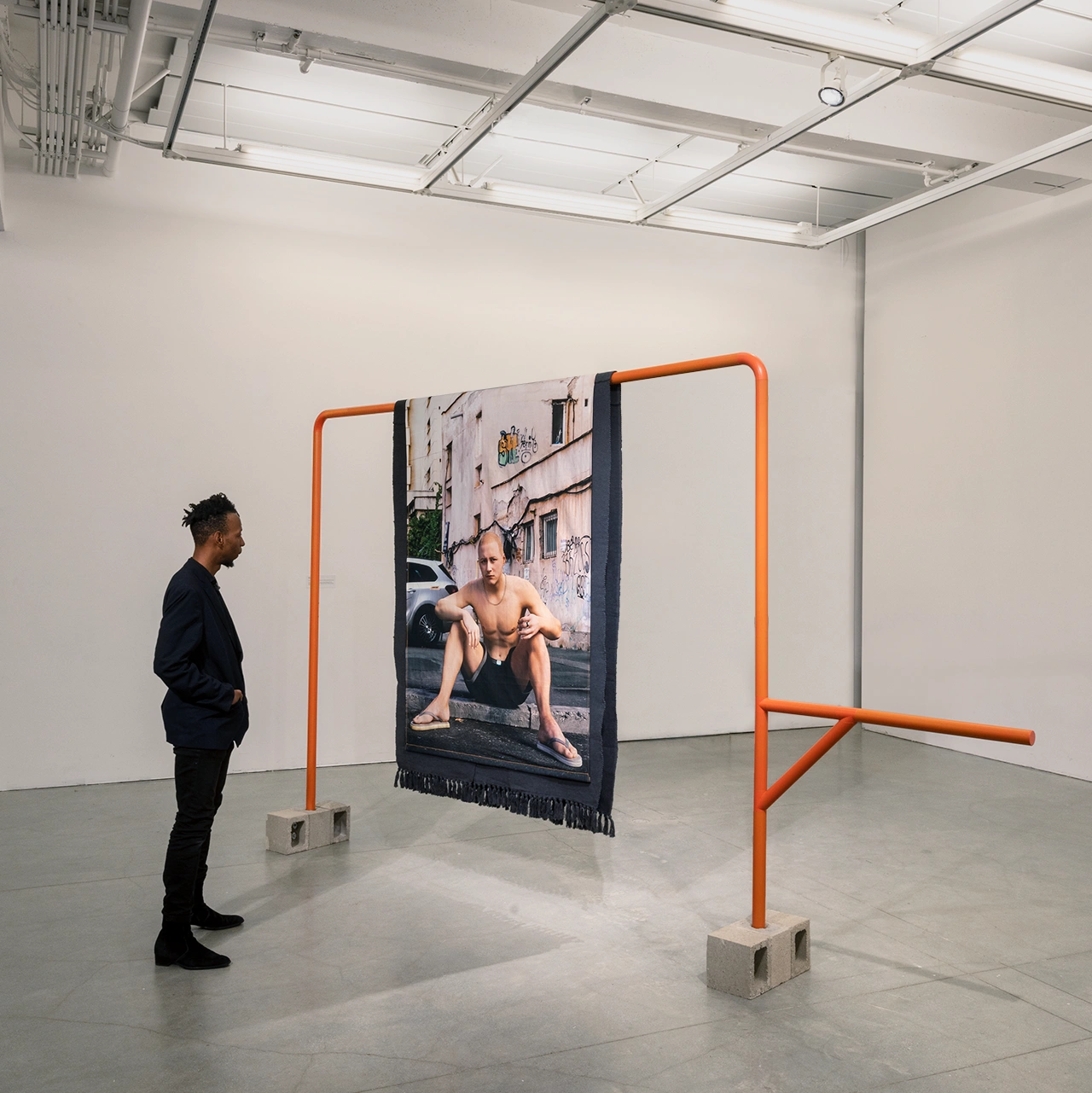
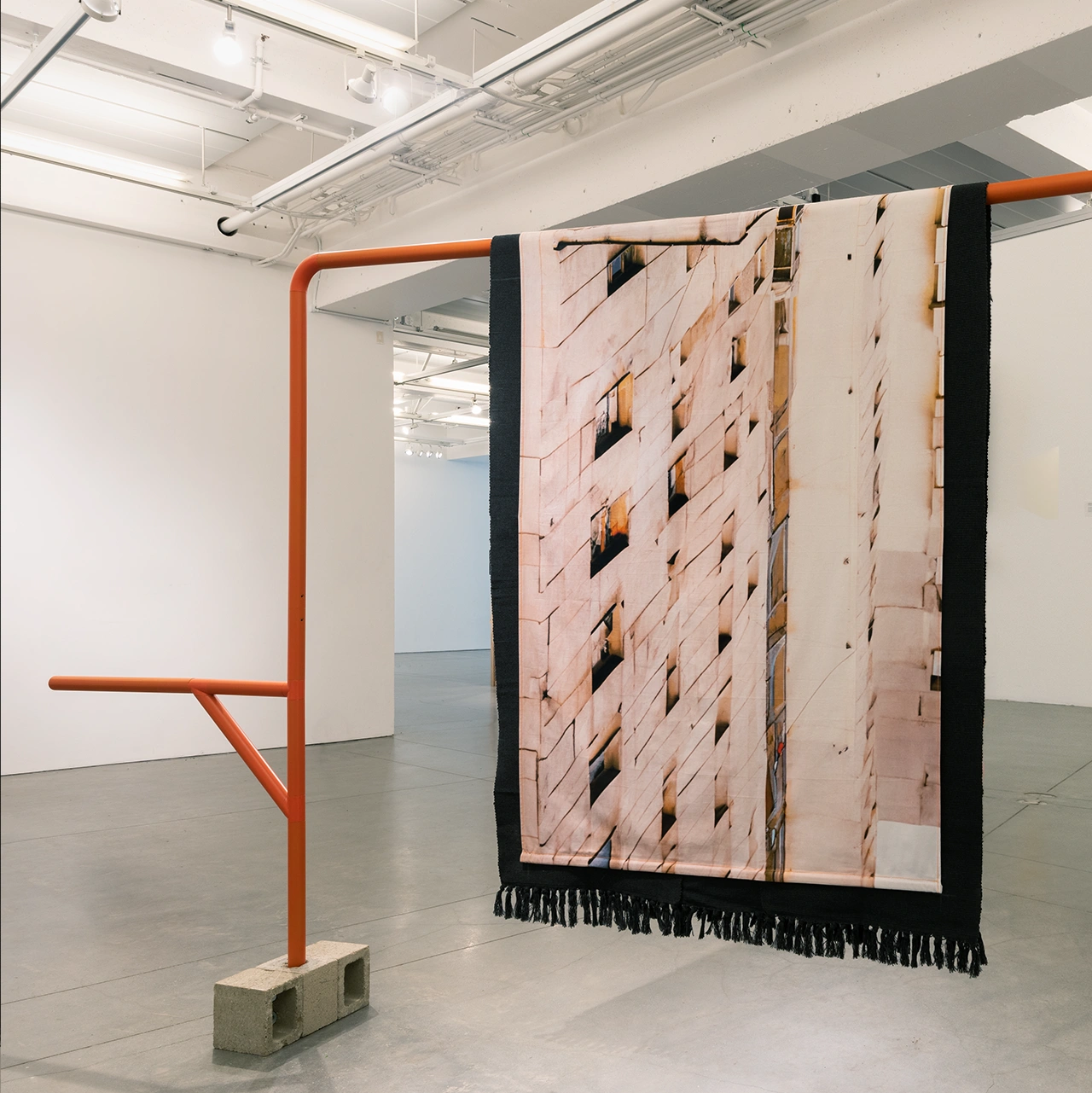
“The process was pretty quick and, honestly, during that period I sometimes took decisions more intuitively than conceptually because there wasn’t enough time to fully think them through. But that’s also the interesting part: afterward you have time to reflect on what you did and understand where those choices actually came from.”
In this case, Aurora says, the work also became an expression of materiality because it was the first time she wasn’t only working digitally. It was something printed, physically built, installed in space. The work was printed onto textile resembling a carpet and mounted on a structure built in the fabrication lab using tubes and 3D-designed, 3D-printed elements. It involved a lot of physical labor: painting, assembling, testing materials, sometimes working nights in the studio. The artist also acquired many new technical skills, from sewing to working with machinery and understanding how to interact with materials.
What mattered was that she wasn’t alone in the process but worked alongside classmates who also labored to complete their projects. She truly felt part of a team.
“I didn’t know what grades other people had and they didn’t know mine. And that was really good. There wasn’t this constant comparison of ‘who did the best.’ You received feedback, but it felt like we were all part of a collective: we gathered here, everyone’s work has value, we give feedback to each other, but there’s no hierarchy. For me it was the first time experiencing that.”
She began realizing how good it feels not to constantly compete with the people around you. She no longer saw others as rivals.
“And that gave me the freedom to experiment more, to learn without the pressure that the result had to be ‘correct’ or ‘top-tier.’ It’s not like I can get a ‘better’ job afterward anyway because ultimately I make experimental art,” Aurora continues. “My perfectionism and ambitions to excel were no longer helping me. When you want to be honest in art, you have to allow yourself to fail, to say something vulnerable, to say something foolish.”
A Complex Feeling: Attraction, Control, Reflection
After finishing Meta Mahala and exhibiting it, the carpet ended up in her studio. Aurora essentially spent hours with Abel staring at her from the wall. She had worked at a 1:1 scale, so Abel’s face was the actual size of a human head.
“That’s exactly what made the experience strange. I was spending time with that ‘character.’ It made me think deeply about the relationship that I had with that ‘man’. I think that’s where my first more serious thoughts about gender began. Until then I'd had many intuitions, but I didn’t know how to articulate them clearly.”
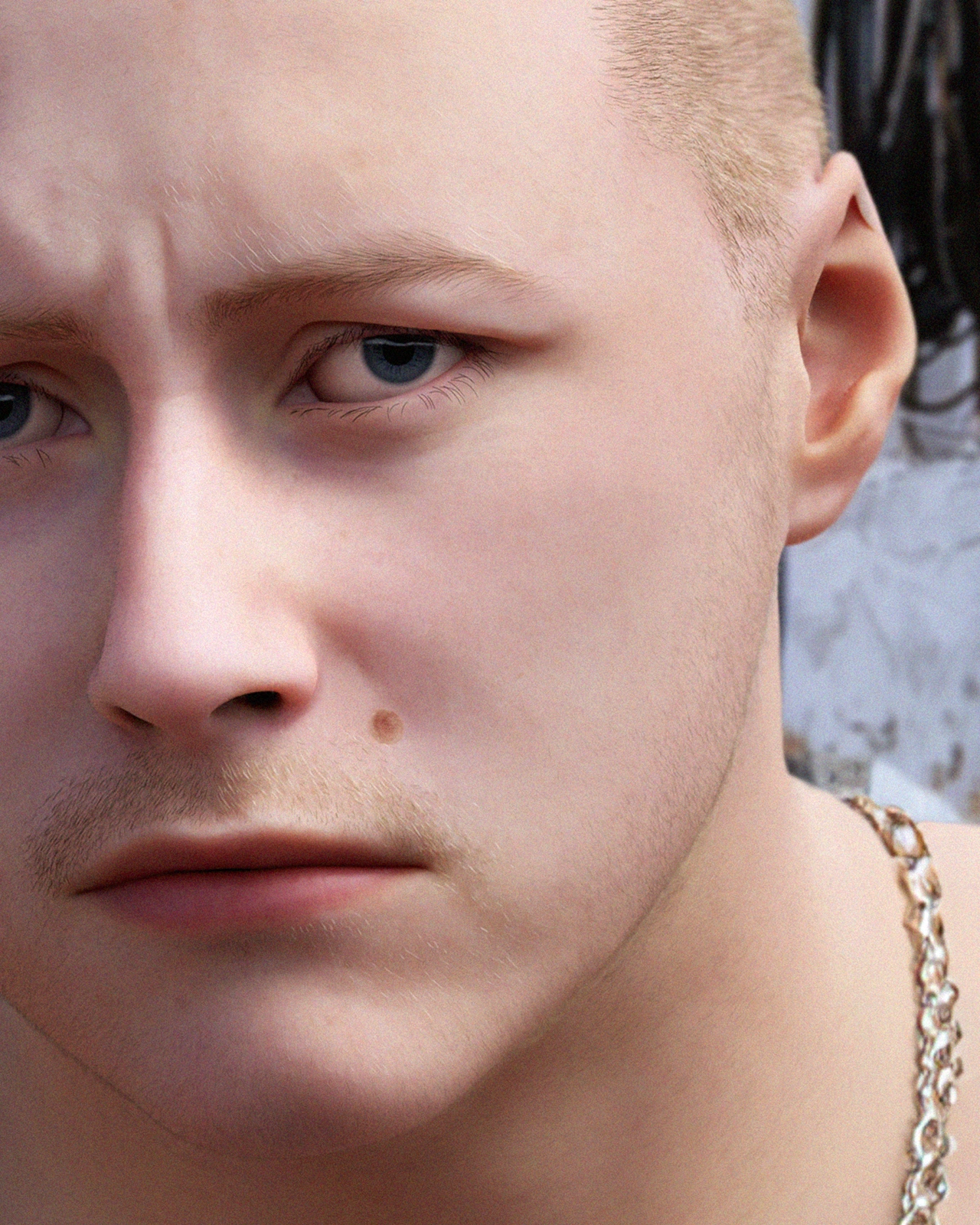
She started thinking about the traditional model of femininity she had grown up with and how she had never identified with what was presented to her then, the idea of wife, mother or traditional roles. She analyzed her decisions and realized how much of her life aligned with what we generally perceive as more “masculine values.”
In Berlin’s tech environment, for example, which was male-oriented, or in other circumstances when she was the only woman in the room, the only one working in 3D. She reflected on what that had meant for her and her work.
“Then all these dynamics kept running through my mind: men working in studios creating hot women or female avatars. If you look on platforms like Midjourney, you frequently see images with ‘big boobs,’ ‘idealized women,’ all kinds of representations of the female body, often created by men,” the artist continues. “The first digital artwork (ASCII) was also a nude woman. And then you start thinking about how these images are constructed and who actually constructs them. It’s a very complicated history regarding representation: who represents whom? And in what way? If you make a female avatar, it’s as if you have control over her.”
For her, the strange moment came when she realized she had created Abel and suddenly could do whatever she wanted with him. She had complete control over him, just like the men creating female avatars. It was a mixture of control and a bizarre attraction.
“It was a very complex feeling. I was thinking: there’s something strange about the idea of creating a ‘person’ you find attractive and over whom you have total control. It’s not something we normally experience. And that pushed me into an even more interesting area of reflection. I wondered: what if I take this further? What if I’m somehow in a relationship with this avatar?”
During that period she was working with a professor from whom she learned the Python programming language, and that’s when the idea emerged to create a system you could converse with.
“At the same time, I was in a long-distance relationship with someone in New York and we talked a lot through messages, so this mediated communication interface already existed. And I found it interesting how much AI and avatars scare us, as if they were something completely ‘other,’ when in reality we already live through digital interfaces all the time—we just no longer perceive them as problematic.”
That’s how she began developing the idea behind Abel & I and, in parallel, the project Genesis—essentially the same world built from a mix of photography, CGI, and AI.
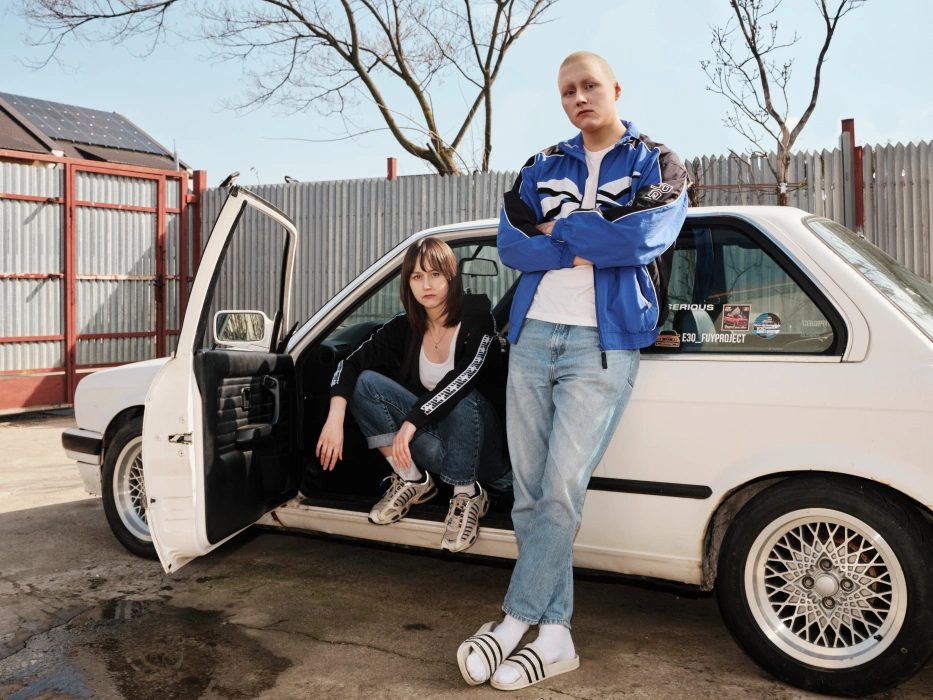
We also spoke about the ethical limits surrounding AI in art. For Aurora and the way she works with artificial intelligence, this kind of technology simply becomes another material, a compositional system. She negotiates the ethical aspect partly through teaching, because she can open clearer discussions with students about what is acceptable with AI, what isn’t, and what implications such technologies carry. The most common question, she says, is whether we can work with this technology and how we might manage to do so, considering that artificial intelligence completely transforms the processes we’ve grown accustomed to.
She remembers that when ChatGPT became popular, she was a teaching assistant for Media History, and suddenly professors had to grade essays they could no longer be entirely sure were written by humans. She doesn’t directly use AI-generated images in her artistic practice, but rather as a conceptual and working tool.
“It’s complicated because it opens up many structural, economic, and political issues. And I think it has shattered many certainties, including the way we understand images, truth, photography, journalism. Before, there was this idea that a photographic image was ‘true.’ But maybe that wasn’t completely true either—it’s just more visible now. It becomes even more complicated when you see how these technologies are used politically, as tools for influencing the collective imagination, regardless of whether an image is real or not. And I think things are only beginning to change.”
We end the conversation talking about the future and how uncertain it is, but also how small and powerless we sometimes feel within all of this.
***
In March, Aurora and I spoke over a video call. She had recently found out she received her artist visa to move to the United States, where she is set to participate in the exhibition Total Flow at the New Museum in New York as a member of NEW INC’s Art & Code Y12— the museum’s cultural incubator program dedicated to artists working at the intersection of art and technology. The exhibition, curated by Mindy Seu, a technology-focused artist and author of Cyberfeminism Index, can be visited between June 3 and June 10. Aurora Mititelu will also participate in a talk alongside five other artists discussing how their practices intersect with computational technology and research.
Every time Aurora and I met, we spoke about leaving and how difficult that process can be. All the images of her detailed plans, her organization and determination somehow made me reflect more carefully on how Aurora’s art itself feels and on the idea of control behind it, which she herself often mentioned.
Since then, I’ve returned many times to our conversations, to the ideas and questions her work raises about autonomy and identity, but also about our relationship with technological systems we still do not fully understand.
I see Aurora in her new home in New York during a video call, smiling as she tells me she finally feels she's found her place in the United States. And I felt it too, even through the screen.
The images in the article were edited by Aurora Mititelu and photographed by Nur Khamis. Special thanks to Filippos Charangionis (model for Abel), Bogdan Fuior, and Andrei Lungu for helping with the space.